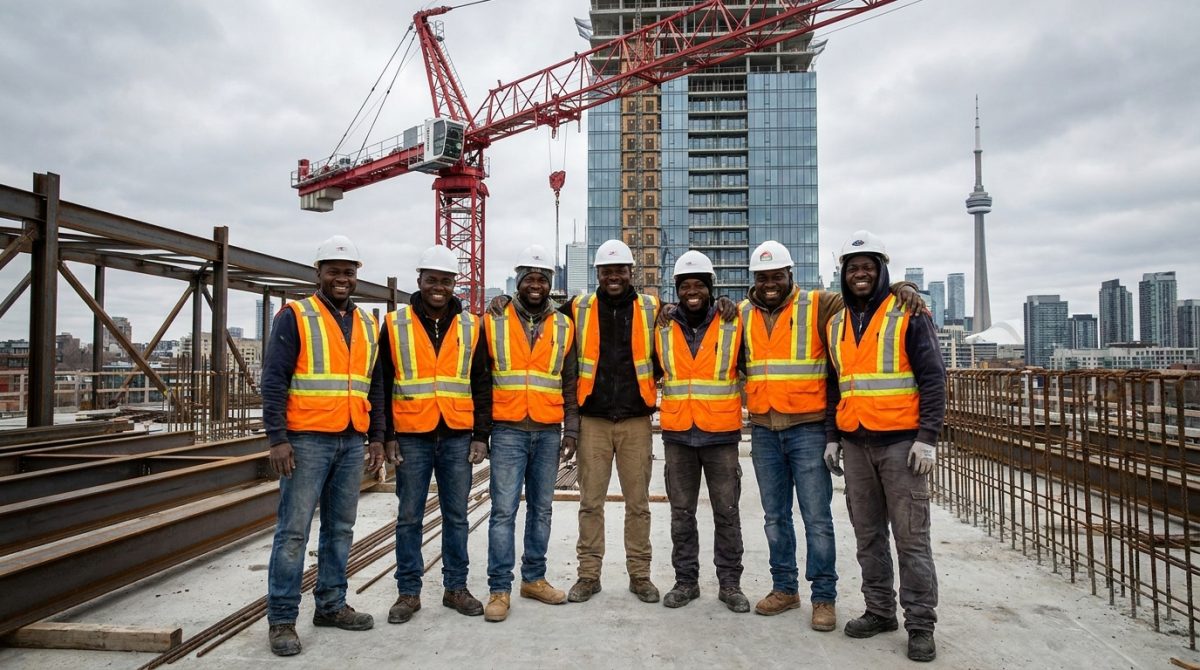
High-paying construction jobs in Canada with visa sponsorship are among the most realistic routes for a foreign worker to move to Canada, earn a strong wage, and convert that work into permanent residence. Canada’s construction industry is facing a labour shortage measured in the hundreds of thousands, and provincial governments have responded by opening immigration pathways aimed squarely at skilled tradespeople.
For foreign workers this has created something unusual: a sector where employers are actively willing to sponsor work permits, where wages are high, and where the work itself can lead directly to permanent residence and full settlement rights for your family.
This guide explains how that process actually works — the visa types, the salary ranges, the employer sponsorship mechanics, the permanent residence routes including Express Entry and the Rural Community Immigration Pilot (RCIP), and the verification steps that protect you from recruitment fraud.
Quick summary: Most construction sponsorship in Canada runs through an employer-obtained LMIA (Labour Market Impact Assessment), which supports a closed work permit. Skilled trades then have several PR routes — Express Entry’s Federal Skilled Trades stream and category-based trades draws, Provincial Nominee Programs, the Atlantic Immigration Program, and RCIP. Verify every offer against Job Bank and every consultant against the CICC register.
Why Canada Sponsors Foreign Construction Workers
Canada’s construction demand is driven by three forces at once: a federal housing programme targeting a very large increase in home building, major infrastructure and energy projects, and an ageing trades workforce. The result is persistent unfilled vacancies in exactly the occupations that are hardest to train quickly — electricians, plumbers, welders, heavy equipment operators and site supervisors.
When an employer cannot fill a role locally, Canadian immigration policy allows them to recruit abroad, provided they can demonstrate the shortage is genuine. That demonstration is the LMIA, and it is the foundation of most construction sponsorship.
Types of Construction Jobs Available With Sponsorship
Canada classifies occupations using the National Occupational Classification (NOC) and its TEER categories. This matters because your NOC code determines which visa and which PR streams you can access.
| Occupation | NOC Code | TEER | Typical Wage Range (CAD) | PR Access |
|---|---|---|---|---|
| Electrician (construction) | 72200 | TEER 2 | $30–52 / hour | Strong — FST, PNP, category draws |
| Plumber | 72300 | TEER 2 | $28–50 / hour | Strong |
| Welder | 72106 | TEER 2 | $25–45 / hour | Strong |
| Carpenter | 72310 | TEER 2 | $25–45 / hour | Strong |
| Heavy equipment operator | 73400 | TEER 3 | $25–45 / hour | Moderate — PNP, RCIP |
| Crane operator | 72500 | TEER 2 | $30–55 / hour | Strong |
| Bricklayer | 72320 | TEER 2 | $26–46 / hour | Strong |
| Construction manager | 70010 | TEER 0 | $80,000–160,000 / year | Strong — FSW, PNP |
| Construction labourer | 75110 | TEER 5 | $17–28 / hour | Limited — RCIP, some PNP |
The pattern is worth understanding: TEER 2 skilled trades have the widest range of PR options. TEER 5 general labour roles can still be sponsored, but the permanent residence routes are narrower and often depend on regional programmes such as RCIP.

Visa Types for Construction Work in Canada
| Permit Type | LMIA Needed? | Duration | Employer Tied? |
|---|---|---|---|
| Employer-specific (closed) work permit | Yes, usually | 1–3 years, renewable | Yes — one named employer |
| Open work permit | No | Varies | No |
| Global Talent Stream | Yes (expedited) | Up to 3 years | Yes |
| Provincial Nominee work permit support | Varies | Until PR processed | Usually |
| Atlantic Immigration Program permit | No LMIA | Bridging to PR | Designated employer |
| RCIP-linked permit | No LMIA | Bridging to PR | Designated employer |
Most construction workers arrive on an employer-specific work permit supported by an LMIA. The important consequence is that you may only work for the employer named on the permit. Changing employers requires a new permit application.
Visa Requirements for Employment
To be approved for a Canadian work permit tied to a construction job, you will generally need to satisfy the following:
- A genuine job offer from a Canadian employer, supported by a positive LMIA where required.
- Proof of qualifications — trade certificates, apprenticeship records, or an Educational Credential Assessment where a PR application is involved.
- Demonstrated experience in the occupation, usually two or more years, documented through reference letters that state your duties, hours and dates.
- Language ability — IELTS General or CELPIP for English, TEF Canada for French. Required for PR; increasingly requested for work permits.
- Medical examination by an IRCC-approved panel physician.
- Police clearance certificates from every country where you have lived six months or more since age 18.
- Proof of funds sufficient for initial settlement.
- Valid passport covering the intended period of employment.
Steps to Get Visa Sponsorship
- Confirm your NOC code. Use the official NOC tool on canada.ca. Everything downstream depends on this classification being correct.
- Assess your eligibility honestly. Run the free Come to Canada assessment tool before spending money on anything.
- Prepare credentials early. Trade certification, an ECA if pursuing PR, and language testing all take weeks to months.
- Apply to employers directly. Target companies with a documented history of sponsorship — large general contractors and industrial builders.
- Secure a written job offer. It should state the NOC code, wage, hours, location and duration.
- Employer applies for the LMIA. This is the employer’s responsibility and their cost. Processing commonly takes several months.
- Apply for your work permit once the positive LMIA is issued, using the LMIA number and your offer letter.
- Complete biometrics and medicals as instructed.
- Receive your Port of Entry letter and travel. Your actual permit is issued at the border.
- Begin building PR eligibility from your first day of Canadian work experience.
The LMIA fee is the employer’s legal responsibility. Under Canadian rules an employer may not recover the LMIA processing fee from the worker. If a recruiter asks you to pay it, that is a violation — and very often a scam.

Employment Agencies and International Recruitment
Rather than list agency phone numbers that change and are widely impersonated, the safer approach is to work from official sources and verify independently.
| Resource | What It Is | Official Website |
|---|---|---|
| Job Bank | Government of Canada job board; LMIA roles are posted here | jobbank.gc.ca |
| CICC | Regulator — verify any immigration consultant here | college-ic.ca |
| Randstad Canada | Large staffing firm with construction desks | randstad.ca |
| Hays Canada | Recruiter covering construction and property | hays.ca |
| Adecco Canada | Industrial and skilled trades staffing | adecco.ca |
| Provincial job boards | Province-specific vacancy listings | Via each provincial government site |
How to verify a recruiter is legitimate: licensed representatives who charge for immigration advice must be registered with the CICC, or be a lawyer in good standing with a provincial law society, or a Quebec notary. Search the register yourself. A genuine consultant will give you their registration number without hesitation.
Companies Offering Visa-Sponsored Construction Jobs
The employers below are among Canada’s largest construction firms and recruit internationally. Apply through their official careers portals — addresses and phone numbers circulating in job-scam messages frequently impersonate these companies.
| Company | Focus | Head Office Address | Telephone | Website |
|---|---|---|---|---|
| EllisDon | Buildings, infrastructure | 1004 Middlegate Road, Suite 1000, Mississauga, ON L4Y 1M4 | 905.896.8900 | ellisdon.com |
| Aecon Group | Infrastructure, energy, utilities | 20 Carlson Court, Suite 105, Toronto, ON M9W 7K6 | (416) 297-2600 | aecon.com |
| Bird Construction | Industrial, institutional | 5700 Explorer Drive, Suite 400, Mississauga, ON L4W 0C6 | 905.602.4122 | bird.ca |
| Ledcor Group | Civil, infrastructure, mining | Suite 1500, 1055 West Hastings St., Vancouver, BC V6E 2E9 | 604-681-7500 | ledcor.com |
| Graham Construction | Buildings, industrial, civil | 10840 – 27 Street SE, Calgary, AB T2Z 3R6 | 403.570.5000 | grahambuilds.com |
| Pomerleau | Buildings, civil engineering | 521 6e Avenue Nord, Saint-Georges, QC G5Y 0H1 | (418) 228-6688 | pomerleau.ca |
| PCL Construction | Buildings, civil, industrial | Head office: Edmonton, Alberta — street address via official site | See official site | pcl.com |
These are corporate head office numbers, not recruitment hotlines. Applications go through each company’s official careers portal. Scam operations routinely clone these firms’ names and quote real head office addresses to appear credible — a genuine address in a message proves nothing on its own. Verify the sender’s email domain matches the company’s real website, and never pay a fee.
Permanent Residence Pathways
This is where construction work in Canada becomes genuinely valuable: several routes convert temporary work into permanent status.
Express Entry
Express Entry manages three federal programmes. For trades, the relevant ones are the Federal Skilled Trades Program (FSTP) and the Canadian Experience Class (CEC) once you have Canadian work experience. Candidates receive a Comprehensive Ranking System (CRS) score, and IRCC issues invitations through periodic draws.
Critically, IRCC runs category-based selection draws, and trades occupations have been a designated category. These draws use lower CRS cut-offs than general draws, which is a meaningful advantage for tradespeople. Official information: canada.ca Express Entry.
Rural Community Immigration Pilot (RCIP)
RCIP is a permanent-residence pathway for people willing to work in smaller communities facing acute labour shortages. It launched in 2025 and now operates across 14 participating communities in six provinces, including Sault Ste. Marie, Thunder Bay and North Bay in Ontario, and Pictou County in Nova Scotia.
The mechanics differ from Express Entry in an important way: you need a job offer from a designated employer within a participating community, and the community itself recommends your application. Requirements are often more accessible than federal streams — lower language and experience thresholds in some cases — in exchange for a commitment to settle in that region. Each community publishes its own priority occupation list, and construction trades feature on several. Official information: canada.ca RCIP.
Other PR Routes
| Programme | How It Works | Best For | Official Source |
|---|---|---|---|
| Provincial Nominee Program (PNP) | A province nominates you; adds 600 CRS points | Workers with a provincial job offer | canada.ca / provincial sites |
| Atlantic Immigration Program | Designated employer in the four Atlantic provinces | NB, NS, PEI, NL placements | canada.ca |
| Francophone Community Immigration Pilot | French-speaking workers outside Quebec | French speakers | canada.ca |
| Quebec Skilled Worker | Quebec selects independently | French speakers in Quebec | quebec.ca |
| Canadian Experience Class | One year of skilled Canadian work | Those already on a work permit | canada.ca |
Settlement Benefits for Sponsored Workers and Their Families
Wages are only part of the value of a sponsored construction job in Canada. The settlement package attached to legal work status is, for many families, worth more than the salary difference alone.
| Benefit | Available on a Work Permit? | Available with PR? | Notes |
|---|---|---|---|
| Public healthcare | Usually yes | Yes | Provincially administered; some provinces apply a waiting period, so private cover may be needed initially |
| Free public schooling (K–12) | Yes, for dependent children | Yes | Children of most work permit holders can attend without a separate study permit |
| Spousal open work permit | Often yes | Yes | Depends on your occupation’s skill level — check current eligibility |
| Canada Child Benefit | Conditional | Yes | Tax-free monthly payment; residency conditions apply |
| Employment standards protection | Yes | Yes | Minimum wage, overtime, rest periods and safety rules apply regardless of status |
| Workers’ compensation | Yes | Yes | Injury coverage is mandatory for construction employers |
| Freedom to change employers | No (closed permit) | Yes | The single biggest practical gain from obtaining PR |
| Path to citizenship | No | Yes | Generally available after three years of physical presence within a five-year window |

Two points deserve emphasis. First, your labour rights do not depend on your immigration status — provincial employment standards and workplace safety law protect temporary foreign workers exactly as they protect citizens, and an employer who tells you otherwise is misleading you. Second, permanent residence is what removes employer dependency. Until PR, a closed work permit ties you to one company, which is precisely why exploitative employers target permit holders. Treat the PR application as the real objective, not an optional extra.
Settlement support is also available free of charge. IRCC funds settlement agencies across Canada that provide language training, employment counselling and orientation at no cost to newcomers — these are listed through the official service locator on canada.ca. You do not need to pay a private relocation company for services the government already funds.
Requirements and Documents Checklist
- Valid passport with adequate remaining validity
- Signed job offer letter stating NOC, wage and hours
- Positive LMIA number (where applicable)
- Trade certification and apprenticeship documentation
- Employment reference letters detailing duties and dates
- Language test results (IELTS, CELPIP or TEF)
- Educational Credential Assessment for PR applications
- Police clearance certificates
- Medical examination from a panel physician
- Proof of settlement funds
- Digital photographs meeting IRCC specifications
Meeting the Eligibility Requirements
Two areas cause most refusals. The first is proving experience: IRCC wants reference letters that describe your actual duties in terms matching the NOC description, on company letterhead, with dates, hours per week and the signatory’s contact details. Vague letters get applications refused.
The second is trade certification. Trades are provincially regulated in Canada, and several are compulsory-certified in certain provinces. Some trades allow you to work while pursuing certification through the Red Seal endorsement; others do not. Check the requirements of the specific province where the job is located before you commit.
Applying at the Embassy and Work Visa Verification
Canada processes most applications online through the IRCC portal, with biometrics and document submission handled at Visa Application Centres (VACs) operated by authorised partners such as VFS Global.
To find the correct centre for your country, use the official locator rather than searching for addresses independently — fraudulent “visa offices” are a recurring problem in high-emigration countries. Canada’s visa offices do not charge fees beyond the published amounts, do not guarantee outcomes, and do not contact applicants demanding urgent payment.
Embassy Contacts and Verification Channels
Use these official routes to confirm anything you have been told. We deliberately publish the official channels rather than third-party phone numbers, because impersonation of Canadian visa offices is one of the most common frauds targeting construction applicants.
| What You Need | Official Channel | Where to Find It |
|---|---|---|
| Your nearest Canadian embassy or consulate | Global Affairs Canada office directory | international.gc.ca — offices abroad |
| Your Visa Application Centre | IRCC VAC locator | canada.ca — find a VAC |
| Application status or case enquiry | IRCC web form and secure account | canada.ca — contact IRCC |
| Confirm a consultant is licensed | CICC public register | college-ic.ca |
| Confirm a lawyer is in good standing | Provincial law society directory | Law society of the relevant province |
| Report suspected immigration fraud | Canadian Anti-Fraud Centre | antifraudcentre-centreantifraude.ca |
| Verify an LMIA or employer | Employment and Social Development Canada | canada.ca — hire a temporary worker |
Verification rule: every legitimate fee is published on canada.ca and paid through official channels. If a fee is requested by bank transfer to an individual, cryptocurrency, or a payment app, it is fraudulent.
Mistakes to Avoid During the Process
- Paying for a job offer. Selling LMIA-backed job offers is illegal. Workers who pay are often left with a worthless document.
- Using an unlicensed consultant. Verify on the CICC register before paying anyone.
- Misrepresenting experience. Misrepresentation carries a five-year ban from Canada. Inflating a CV is not worth that risk.
- Choosing the wrong NOC code. This single error can invalidate an otherwise strong application.
- Ignoring provincial certification rules. A job offer does not override provincial trade licensing.
- Letting documents expire. Language tests and police certificates have limited validity.
- Working outside your permit conditions. A closed permit means one employer only.
- Assuming a work permit equals PR. It does not — PR requires a separate application.
How to Apply for Construction Jobs in Canada With Visa Sponsorship
Apply only through official portals and employer career sites. The sequence below is the one that works; anything that skips a step is worth treating with suspicion.
- Search Job Bank for postings flagged as available to candidates requiring an LMIA, filtering by your NOC code and target province.
- Apply directly on employer career portals for the companies listed above, attaching a CV formatted to Canadian conventions — duties phrased to match your NOC description.
- Register with licensed recruiters reached through their official domains.
- Interview and negotiate a written offer specifying NOC code, wage, hours, location and duration.
- Wait for the employer’s LMIA to be approved — at their cost, not yours.
- Submit your work permit application through the IRCC secure account, attaching the LMIA number and offer letter.
- Complete biometrics and the medical exam at an approved centre.
- Travel on your Port of Entry letter and collect the permit at the border.
| Purpose | Official Website |
|---|---|
| Government job board (LMIA roles) | jobbank.gc.ca |
| Immigration applications and account | canada.ca/immigration |
| Eligibility self-assessment | canada.ca — Come to Canada tool |
| Express Entry profile | canada.ca — Express Entry |
| Consultant verification | college-ic.ca |
| Processing times | canada.ca — check processing times |
Frequently Asked Questions
Can I get a construction job in Canada with visa sponsorship without experience?
It is difficult but not impossible. General labourer roles (NOC 75110) have the lowest entry barrier, and some employers will sponsor for high-demand seasonal work. However, an LMIA requires the employer to prove they could not find a Canadian, which is harder to argue for unskilled roles. Two or more years of documented trade experience makes sponsorship substantially more likely and opens far more permanent residence routes.
How much does it cost to get a sponsored construction job in Canada?
Your costs are the work permit application fee, biometrics, medical examination, language testing, police certificates and credential assessment — typically CAD $1,000–2,500 in total depending on family size. The LMIA fee is the employer’s legal responsibility and cannot be charged to you. Any request that you pay for the job offer itself is illegal.
How long does the whole process take?
Realistically six to eighteen months from starting your job search to arriving in Canada. The LMIA stage is usually the longest single step. Permanent residence through Express Entry adds a further six to twelve months after you become eligible.
Can I bring my spouse and children?
Yes. Spouses of many skilled work permit holders can apply for an open work permit allowing them to work for any employer, and dependent children can attend Canadian public schools without a separate study permit. Eligibility depends on your occupation’s skill level, so confirm current rules for your NOC.
Do I need a Red Seal certification to apply?
Not necessarily for a work permit, but Red Seal endorsement significantly improves employability and permanent residence scoring. More importantly, several trades are compulsory-certified in certain provinces, meaning you legally cannot work in them without provincial certification. Check the rules for the specific province where the job is located.
Can construction labourers get permanent residence?
It is harder through federal streams, which favour TEER 0–3 occupations. However, regional programmes including the Rural Community Immigration Pilot and several Provincial Nominee streams do accommodate lower-TEER occupations, particularly where a community has an acute shortage.
What is an LMIA and do I need one?
A Labour Market Impact Assessment is a document from Employment and Social Development Canada confirming that hiring a foreign worker will not negatively affect the Canadian labour market. Most construction sponsorship requires one. Exceptions include the Atlantic Immigration Program and RCIP, which use designated employers instead.
Can I change employers after arriving in Canada?
Not on a closed work permit without applying for a new one. Your permit names a single employer. This is the main practical reason to pursue permanent residence, which removes employer dependency entirely.
Is my job offer valid if the recruiter asks for payment?
Treat it as fraudulent. Canadian employers cannot legally recover LMIA fees from workers, and licensed recruiters in most provinces are prohibited from charging job seekers placement fees. Verify the consultant on the CICC register and report suspected fraud to the Canadian Anti-Fraud Centre.
Which Canadian province is best for construction jobs?
Alberta, Ontario and British Columbia have the largest construction labour markets and the highest wages. However, smaller communities participating in RCIP often offer easier permanent residence pathways in exchange for a commitment to settle there, which can be the faster route to PR overall.
Final Word
Canada’s construction shortage is real, the wages are genuinely high by international standards, and the permanent residence routes for skilled trades are among the most accessible in the developed world. What undermines applicants is rarely the immigration system itself — it is fraud, poor documentation and incorrect occupational classification.
Work from official sources, verify every intermediary, insist that the employer bears the LMIA cost, and treat any request for payment in exchange for a job offer as the warning sign it is.
This article is general information, not legal advice. Immigration rules change frequently — confirm all requirements on canada.ca before acting. See our Disclaimer.