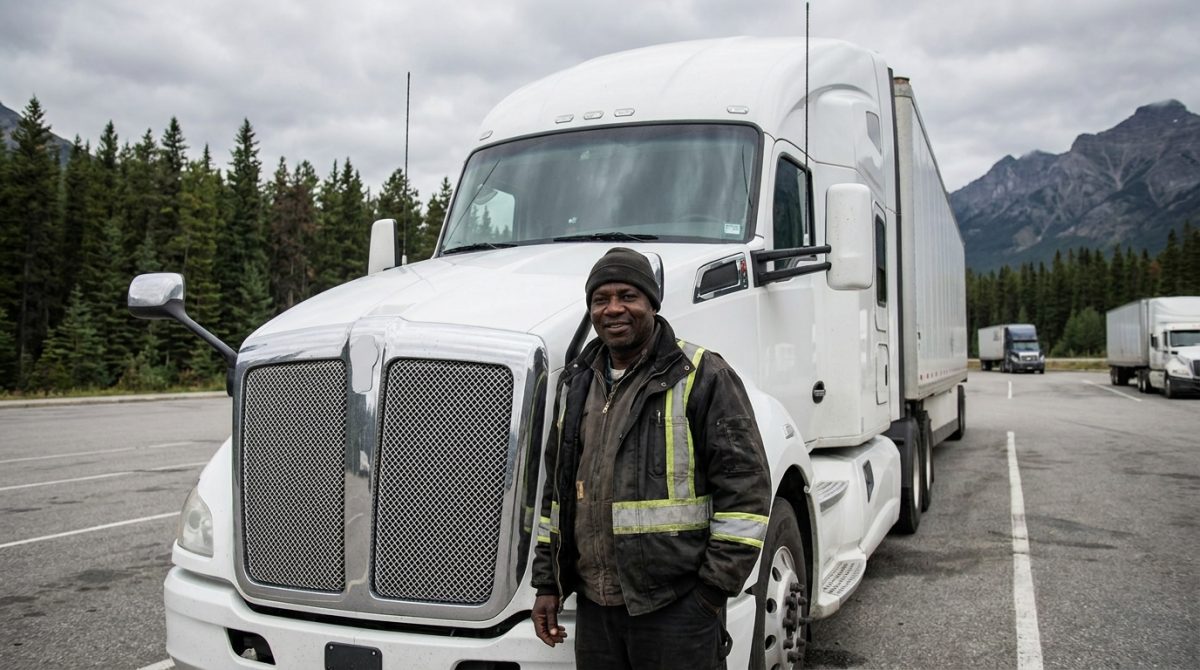
Truck driver jobs in Canada with LMIA visa sponsorship are one of the few routes that allow a foreign worker with a trade licence rather than a university degree to reach Canada legally, earn CAD $55,000 to $90,000 a year, and build a documented path to permanent residence.
Canada’s trucking sector has been short of drivers for over a decade. Trucking HR Canada has consistently reported vacancy rates well above the national average, and the shortage is structural: the workforce is ageing, domestic recruitment has not kept pace, and freight volumes continue to grow. That gap is why employers are willing to go through the cost and paperwork of a Labour Market Impact Assessment (LMIA) to hire abroad.
Quick summary: Transport truck drivers fall under NOC 73300 (TEER 3). Sponsorship almost always requires an employer-obtained LMIA supporting a closed work permit. You will need a Canadian commercial licence (Class 1 / AZ), which means completing provincial Mandatory Entry-Level Training after arrival. PR routes run mainly through Provincial Nominee Programs and the Canadian Experience Class. Verify every employer on Job Bank and every consultant on the CICC register.
Why Canada Sponsors Foreign Truck Drivers
Roughly two-thirds of Canada’s trade by value moves by road. When drivers are scarce, freight costs rise across the entire economy, which is why both federal and provincial governments have treated the shortage as an economic priority rather than an industry complaint.
For a Nigerian driver, the practical significance is this: trucking is one of the very few occupations where Canadian employers routinely sponsor candidates without degrees, and where several provinces have built dedicated immigration streams specifically to retain those drivers permanently.
Types of Truck Driving Jobs Available With Sponsorship
Not all driving work is classified the same way, and the classification determines your immigration options.
| Role | NOC Code | TEER | Typical Earnings (CAD) | Sponsorship Likelihood |
|---|---|---|---|---|
| Long-haul transport truck driver | 73300 | TEER 3 | $55,000–90,000 / year | High |
| Regional / short-haul driver | 73300 | TEER 3 | $48,000–70,000 / year | Moderate |
| Flatbed / specialised freight | 73300 | TEER 3 | $65,000–95,000 / year | High |
| Tanker / dangerous goods | 73300 | TEER 3 | $70,000–100,000 / year | High — endorsements needed |
| Heavy haul / oversize | 73300 | TEER 3 | $75,000–110,000 / year | Moderate — experience critical |
| Delivery / courier driver | 75201 | TEER 5 | $36,000–50,000 / year | Low |
| Bus driver | 73301 | TEER 3 | $45,000–70,000 / year | Moderate |
| Dispatcher / fleet supervisor | 13201 | TEER 3 | $50,000–75,000 / year | Moderate |
The distinction that matters most: NOC 73300 at TEER 3 qualifies for far more immigration streams than TEER 5 delivery work. If your goal is permanent residence, long-haul transport driving is the stronger target even though the lifestyle is harder.
Visa Types for Truck Driving Work in Canada
| Permit Type | LMIA Required? | Duration | Employer Tied? |
|---|---|---|---|
| Employer-specific (closed) work permit | Yes | 1–3 years, renewable | Yes — one named employer |
| Provincial Nominee supported permit | Varies | Until PR is processed | Usually |
| Bridging Open Work Permit | No | While PR is in process | No |
| Spousal open work permit | No | Matches principal permit | No |
| Permanent residence | No | Indefinite | No |
Visa Requirements for Employment
- A written job offer from a Canadian carrier, supported by a positive LMIA.
- Commercial driving experience — most carriers want two or more years on articulated vehicles, documented in reference letters.
- A valid Nigerian driving licence in the appropriate class, plus a certified translation if not in English.
- A clean driving abstract from the Federal Road Safety Corps or your licensing authority.
- Language ability — IELTS General or CELPIP. This is not optional in practice: drivers must read road signs, complete logbooks and communicate at border crossings.
- Medical examination by an IRCC panel physician, plus a commercial driver medical after arrival.
- Police clearance certificates from every country of residence since age 18.
- Proof of funds for initial settlement.
- Valid international passport.
You cannot drive commercially in Canada on a Nigerian licence. You must obtain a provincial Class 1 (or AZ in Ontario) licence, which requires completing Mandatory Entry-Level Training. Any recruiter claiming you can start driving immediately on your existing licence is either misinformed or lying.
Steps to Get Visa Sponsorship
- Document your driving history properly. Reference letters must state vehicle types, routes, years, and hours per week on company letterhead.
- Take a language test early. Weak English is the single most common reason Nigerian driver applications stall.
- Apply directly to carriers that run international recruitment programmes — the larger fleets listed below.
- Complete the carrier’s assessment. Many run remote interviews and, increasingly, video-based driving assessments.
- Receive a written job offer stating NOC 73300, wage, pay structure and base terminal.
- Employer applies for the LMIA at their own cost.
- Apply for your work permit through the IRCC portal with the LMIA number.
- Complete biometrics and medicals.
- Arrive and convert your licence — complete MELT and pass the provincial Class 1 road test. Most sponsoring carriers assist with this.
- Begin accumulating Canadian experience toward a PNP nomination or the Canadian Experience Class.
Employment Agencies and International Recruitment
Trucking recruitment attracts a high volume of fraud, so work only from official sources and verify independently.
| Resource | What It Is | Official Website |
|---|---|---|
| Job Bank | Government of Canada job board; LMIA-backed driver roles are posted here | jobbank.gc.ca |
| CICC | Regulator — verify any immigration consultant here before paying | college-ic.ca |
| Trucking HR Canada | National HR body for the sector; publishes employer resources | truckinghr.com |
| Ontario Trucking Association | Industry association; member carrier directory | ontruck.org |
| Canadian Trucking Alliance | National federation of provincial trucking associations | cantruck.ca |
| Canadian Anti-Fraud Centre | Report suspected recruitment fraud | antifraudcentre-centreantifraude.ca |
Companies Offering Visa-Sponsored Truck Driving Jobs
The carriers below are among Canada’s largest and have recruited internationally. Head office details were verified against each company’s own published contact information in August 2026.
| Carrier | Head Office Address | Telephone | Website |
|---|---|---|---|
| Bison Transport | 1001 Sherwin Road, Winnipeg, MB R3H 0T8 | (204) 833-0000 / 1-800-GO-BISON | bisontransport.com |
| Challenger Motor Freight | 300 Maple Grove Road, Cambridge, ON N3E 1B7 | (519) 653-6226 / 1-800-265-6358 | challenger.com |
| Day & Ross | 398 Main Street, Hartland, NB E7P 1C6 | 1-800-561-1415 | dayross.com |
| Erb Group | 290 Hamilton Road, New Hamburg, ON N3A 1A2 | (519) 662-2710 / 1-800-665-2653 | erbgroup.com |
| Rosedale Group | Multiple terminals — see official locations page | 1-877-588-0057 | rosedalegroup.com |
Beware of “Driver Inc.” arrangements. Some Canadian carriers misclassify drivers as independent contractors to avoid payroll taxes and benefits. This is illegal, and it leaves you without employment insurance, workers’ compensation or reliable proof of employment for a PR application. If an employer insists you incorporate yourself or invoice them personally, walk away.
Permanent Residence Pathways
Provincial Nominee Programs (the primary route)
For truck drivers, PNPs are usually the strongest option because several provinces have created streams that explicitly accommodate TEER 3 transport occupations. A provincial nomination adds 600 points to your Express Entry Comprehensive Ranking System score, which in practice guarantees an invitation to apply.
Provinces that have operated driver-relevant streams include Saskatchewan, Manitoba, Alberta, Ontario and the Atlantic provinces. Streams open and close, and occupation lists are revised, so always check the current provincial page rather than relying on secondhand information.
Canadian Experience Class
After one year of full-time skilled work in Canada at TEER 0–3, you may qualify for the Canadian Experience Class through Express Entry. NOC 73300 is TEER 3, so long-haul driving counts. This is why the classification on your job offer matters so much.
Rural Community Immigration Pilot (RCIP)
RCIP offers permanent residence through designated employers in 14 participating communities across six provinces. Several participating communities include transport occupations on their priority lists, and requirements are often more accessible than federal streams in exchange for a commitment to settle in that community.
| Programme | How It Works | Best For | Official Source |
|---|---|---|---|
| Provincial Nominee Program | Province nominates you; +600 CRS points | Drivers with a provincial job offer | canada.ca / provincial sites |
| Canadian Experience Class | One year of Canadian TEER 0–3 work | Drivers already on a work permit | canada.ca |
| Rural Community Immigration Pilot | Designated employer in a participating community | Drivers willing to settle rurally | canada.ca |
| Atlantic Immigration Program | Designated employer in NB, NS, PEI or NL | Atlantic Canada placements | canada.ca |
| Express Entry (FSW) | Points-based federal selection | Drivers with strong language scores | canada.ca |
Settlement Benefits for Sponsored Drivers and Their Families
| Benefit | On a Work Permit? | With PR? | Notes |
|---|---|---|---|
| Public healthcare | Usually yes | Yes | Provincial; some provinces apply a waiting period |
| Free public schooling | Yes | Yes | Dependent children need no separate study permit |
| Spousal open work permit | Often yes | Yes | Confirm current eligibility for TEER 3 occupations |
| Canada Child Benefit | Conditional | Yes | Residency conditions apply |
| Workers’ compensation | Yes | Yes | Mandatory coverage — another reason to refuse Driver Inc. |
| Employment Insurance | Yes, if on payroll | Yes | Lost entirely under contractor misclassification |
| Freedom to change employers | No | Yes | The main practical gain from PR |
| Path to citizenship | No | Yes | Generally after three years of physical presence in five |

Settlement services funded by IRCC — language training, employment counselling, orientation — are free to newcomers. You should not pay a private company for services the government already provides at no cost.
Requirements and Documents Checklist
- Valid international passport
- Signed job offer stating NOC 73300, wage and base terminal
- Positive LMIA number
- Nigerian driving licence plus certified English translation
- Driving abstract / record of no serious offences
- Employment reference letters detailing vehicle types and routes
- IELTS General or CELPIP results
- Police clearance certificates
- Panel physician medical
- Proof of settlement funds
- Photographs to IRCC specification
Meeting the Eligibility Requirements
Three areas decide most driver applications. Language is first: officers assess whether you can realistically operate safely and handle documentation in English, and weak scores sink otherwise strong files. Documented experience is second: vague reference letters that fail to specify articulated vehicle experience are routinely rejected. Driving record is third: serious traffic convictions, and any impaired driving history, can render you inadmissible to Canada entirely.
Applying at the High Commission and Work Visa Verification
Canada processes applications online, with biometrics and document submission at Visa Application Centres. Nigerian applicants are served by the Canadian diplomatic missions below, whose details are published by the Government of Canada.
Canadian High Commission Contacts in Nigeria
| Office | Address | Telephone | |
|---|---|---|---|
| High Commission of Canada, Abuja | 13010G Palm Close, Diplomatic Drive, Central Business District, Abuja (P.O. Box 5144) | +234 (209) 461 2900 | abuja@international.gc.ca |
| Deputy High Commission of Canada, Lagos | 4 Anifowoshe Street, Victoria Island, Lagos | +234 201 271 5665 | lagosconsular-consulaire@international.gc.ca |
| What You Need | Official Channel |
|---|---|
| Book biometrics / submit documents | IRCC Visa Application Centre locator on canada.ca |
| Check application status | IRCC secure account on canada.ca |
| Verify an immigration consultant | college-ic.ca |
| Verify an employer or LMIA | ESDC via canada.ca |
| Report recruitment fraud | Canadian Anti-Fraud Centre |
The High Commission will never ask you to pay fees to a personal bank account. All Canadian immigration fees are published on canada.ca and paid through official channels only. Requests for payment by transfer to an individual, cryptocurrency or a payment app are fraudulent without exception.
Mistakes to Avoid During the Process
- Paying for a job offer or LMIA. Both are illegal. The LMIA fee is the employer’s cost by law.
- Accepting Driver Inc. terms. It destroys your benefits and weakens your PR evidence.
- Assuming your Nigerian licence transfers directly. It does not; MELT and a provincial road test are required.
- Understating language preparation. Book IELTS early and retake it if scores are marginal.
- Using an unlicensed consultant. Check the CICC register first.
- Misrepresenting your driving record. Misrepresentation carries a five-year ban.
- Ignoring the classification on your offer. A TEER 5 classification quietly closes most PR doors.
- Signing contracts you have not read. Check pay structure, deductions and any training repayment clause.
How to Apply for Truck Driver Jobs in Canada With Visa Sponsorship
- Search Job Bank for NOC 73300 postings open to candidates requiring an LMIA.
- Apply directly through the careers portals of the carriers listed above.
- Prepare reference letters and your driving abstract before interviews begin.
- Complete the carrier’s assessment and interview process.
- Obtain a written offer and wait for the employer’s LMIA approval.
- Submit your work permit application through the IRCC portal.
- Complete biometrics at the Visa Application Centre and your panel medical.
- Travel, complete MELT, and obtain your provincial Class 1 licence.
Frequently Asked Questions
Can a Nigerian driver get a truck driving job in Canada with visa sponsorship?
Yes. Nigerian drivers are recruited by Canadian carriers, though you must meet the same requirements as any other applicant: documented articulated-vehicle experience, acceptable English language scores, a clean driving record, and an employer willing to obtain an LMIA. You will convert to a Canadian commercial licence after arrival.
Do I need Canadian driving experience before applying?
No, but you need documented commercial experience from Nigeria or elsewhere, usually two or more years on articulated vehicles. What you cannot skip is obtaining a Canadian provincial Class 1 licence after you arrive.
How much do truck drivers earn in Canada?
Long-haul drivers typically earn CAD $55,000 to $90,000 a year, with specialised freight such as tanker or heavy haul paying more. Pay may be per mile or hourly, which materially affects take-home earnings — clarify the structure before signing.
What is MELT and do I have to complete it?
Mandatory Entry-Level Training is the minimum training programme required before taking a Class 1 road test in most Canadian provinces. Yes, you must complete it, and many sponsoring carriers arrange and part-fund it for incoming drivers.
Can truck drivers get permanent residence in Canada?
Yes. NOC 73300 is TEER 3, which qualifies for the Canadian Experience Class after one year of Canadian work, and for several Provincial Nominee streams. RCIP is another route for drivers willing to settle in a participating rural community.
How long does the process take?
Typically eight to eighteen months from job search to arrival, with the LMIA the longest stage. Permanent residence usually follows one to three years after you begin working in Canada.
Can I bring my family with me?
Yes. Spouses of many work permit holders can apply for an open work permit, and dependent children can attend public school. Given long-haul schedules, many drivers plan family arrival carefully around their route pattern.
Is it legal for a recruiter to charge me a placement fee?
In most Canadian provinces, charging job seekers a placement fee is prohibited, and recovering the LMIA fee from a worker is illegal everywhere in Canada. Treat any such request as fraud and report it.
What is Driver Inc. and why does it matter?
Driver Inc. describes arrangements where carriers misclassify employee drivers as independent contractors to avoid payroll obligations. It is illegal, strips you of benefits and insurance, and produces weak employment evidence for a permanent residence application.
Which province is best for a sponsored truck driver?
Saskatchewan, Manitoba and Alberta have historically operated the most accessible driver-relevant provincial streams, while Ontario has the largest volume of carriers. The right choice depends on which province currently has an open stream matching your profile.
Final Word
Truck driving remains one of the most realistic sponsored routes into Canada for Nigerian workers without a degree, and one of the few where permanent residence is a genuine expectation rather than a distant hope. The obstacles are rarely the immigration rules themselves — they are weak documentation, marginal language scores, and recruiters selling job offers that were never real.
Insist the employer bears the LMIA cost, refuse contractor misclassification, verify every intermediary on the CICC register, and confirm your offer against Job Bank before you part with anything.
This article is general information, not legal advice. Immigration rules change frequently — confirm all requirements on canada.ca before acting. See our Disclaimer.