
Kitchen helper and restaurant jobs in Canada with visa sponsorship are among the easiest entry-level roles for a Nigerian applicant to actually get hired into. Canadian restaurants are short-staffed year round, they train on the job, and they rarely ask for qualifications.
They are also the roles where the gap between “getting to Canada” and “being able to stay in Canada” is widest. This guide is honest about both halves.
Quick summary: Kitchen helpers are NOC 65201 (TEER 5), food service supervisors NOC 62020 (TEER 2), and cooks NOC 63200 (TEER 3). Sponsorship runs through an employer LMIA. Wages run CAD $16–24 per hour. The cook and supervisor classifications are the ones that lead to permanent residence. Verify postings on Job Bank.
Why Canada Sponsors Foreign Restaurant Workers
Canadian food service has one of the highest staff turnover rates of any sector. The hours are unsociable, the work is physically demanding, and domestic workers move on quickly. Restaurants in smaller cities and rural areas struggle particularly badly, because the local labour pool is small and competition from other employers is fierce.
That is why food service has remained one of the more consistently available LMIA categories even as other low-skill routes have narrowed.
Types of Restaurant Jobs Available With Sponsorship
| Role | NOC Code | TEER | Typical Wage (CAD) | PR Access |
|---|---|---|---|---|
| Kitchen helper / dishwasher | 65201 | TEER 5 | $16–20 / hour | Limited |
| Food counter attendant | 65201 | TEER 5 | $16–20 / hour | Limited |
| Food and beverage server | 65200 | TEER 5 | $16–19 + tips | Limited |
| Cook | 63200 | TEER 3 | $18–28 / hour | Strong — CEC eligible |
| Food service supervisor | 62020 | TEER 2 | $20–30 / hour | Strong |
| Baker | 63202 | TEER 3 | $18–27 / hour | Strong |
| Butcher (retail) | 63201 | TEER 3 | $19–28 / hour | Strong |
| Restaurant manager | 60030 | TEER 0 | $45,000–70,000 / year | Strong |
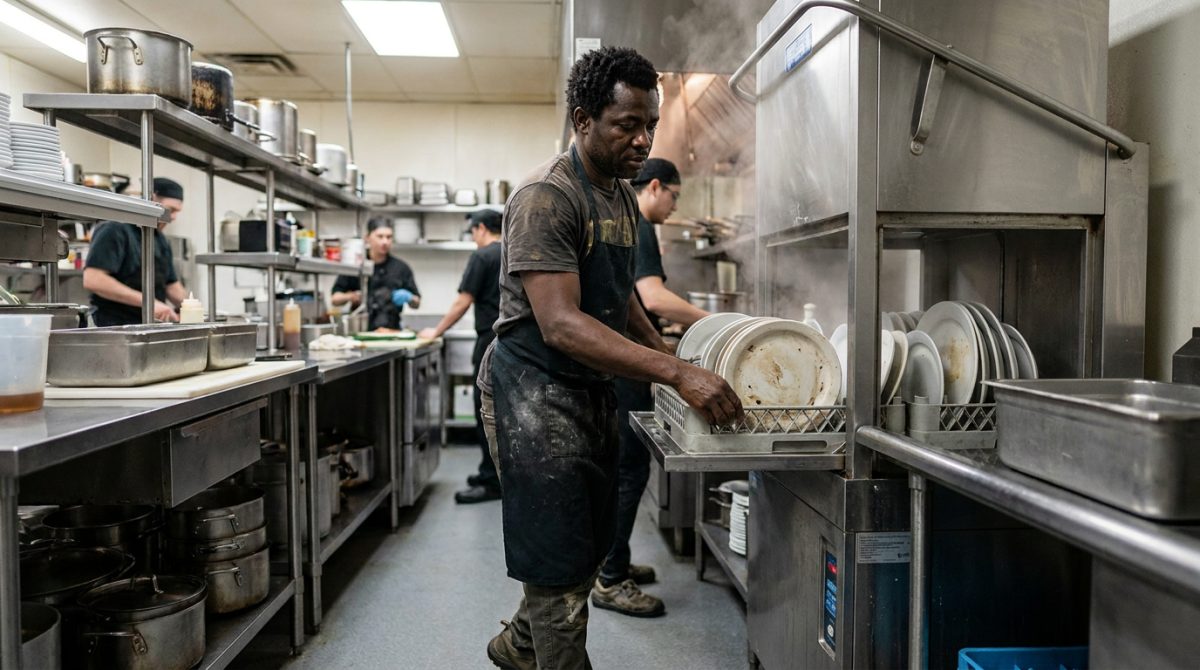
The bolded rows are the point of this entire article. Cook is TEER 3. Food service supervisor is TEER 2. Kitchen helper is TEER 5. These roles sit side by side in the same kitchen, and the immigration consequences are completely different. A kitchen helper has almost no federal permanent residence route. A cook has a direct one.
The Cook Classification: The Most Valuable Detail Here
If you take one thing from this guide, take this. NOC 63200 (Cook) is one of the most accessible TEER 3 occupations in the entire Canadian immigration system.
- It requires no degree and no formal culinary qualification in most cases.
- Relevant experience — including experience gained in Nigeria — can satisfy the requirement.
- It sits at TEER 3, which qualifies for the Canadian Experience Class after one year of Canadian work.
- It appears on several provincial nominee occupation lists.
- Canadian restaurants hire cooks constantly.
If you have genuine cooking experience — in a restaurant, hotel, canteen or catering operation in Nigeria — document it properly and apply as a cook rather than a kitchen helper. Reference letters must state your duties, the dishes and cuisines you prepared, hours worked and dates. That documentation is what converts your experience into an immigration asset.
Do not overstate your experience. Misrepresentation carries a five-year ban from Canada, and employers will discover quickly whether you can actually run a section. Apply as a cook if you genuinely have cooked professionally. If you have not, take the kitchen helper role and target promotion to cook within your first year — that is a realistic and completely legitimate path.

Visa Types for Restaurant Work in Canada
| Route | LMIA Required? | Duration | Notes |
|---|---|---|---|
| Low-wage stream work permit | Yes | Up to 2 years | Kitchen helpers, servers |
| High-wage stream work permit | Yes | Up to 3 years | Cooks, supervisors |
| Provincial Nominee supported permit | Varies | Until PR processed | Cooks appear on several lists |
| RCIP-linked permit | No LMIA | Bridging to PR | Rural restaurants participate |
| Atlantic Immigration Program | No LMIA | Bridging to PR | Strong for Atlantic hospitality |
Visa Requirements for Employment
- A genuine job offer from a Canadian restaurant or food service employer with a positive LMIA.
- Documented experience — essential if applying as a cook, less so for helper roles.
- Basic English for kitchen roles; stronger English for customer-facing positions.
- Food safety certification — provincial requirement, usually obtained after arrival.
- Physical capability for long shifts on your feet in hot kitchens.
- Police clearance certificates from all countries of residence since age 18.
- Valid international passport.
Employment Agencies and Official Resources
| Resource | What It Is | Official Website |
|---|---|---|
| Job Bank | Government job board; LMIA food service roles posted here | jobbank.gc.ca |
| Restaurants Canada | National industry association | restaurantscanada.org |
| CICC | Verify any immigration consultant | college-ic.ca |
| ESDC compliance list | Employers found non-compliant with the TFWP | canada.ca |
| Provincial employment standards | Wages, tips, breaks and overtime rules | Provincial government sites |
Where to look: national restaurant and quick-service chains recruit at scale and have the administrative capacity to run LMIAs, which independent single-site restaurants often do not. Hotel restaurants, catering companies, care home kitchens and remote camp catering operations are also consistent sponsors — and camp catering in particular pays well above urban restaurant rates.
Permanent Residence Pathways
| Programme | Kitchen Helper (TEER 5) | Cook (TEER 3) | Official Source |
|---|---|---|---|
| Canadian Experience Class | No | Yes | canada.ca |
| Express Entry (FSW) | No | Yes | canada.ca |
| Provincial Nominee Program | Some semi-skilled streams | Yes — widely listed | Provincial sites |
| Rural Community Immigration Pilot | Yes, participating communities | Yes | canada.ca |
| Atlantic Immigration Program | Yes, designated employers | Yes | canada.ca |
Settlement Benefits and Your Rights
| Benefit | On a Work Permit? | With PR? | Notes |
|---|---|---|---|
| Employer housing assistance | Yes, low-wage stream | — | Common in rural and camp roles |
| Private health insurance | Yes | — | Until provincial coverage begins |
| Public healthcare | Usually yes | Yes | Provincial |
| Free public schooling | Yes | Yes | Dependent children |
| Tips | Yes | Yes | Employers may not unlawfully withhold them |
| Meals on shift | Commonly provided | — | Deductions are regulated |
| Overtime and breaks | Yes | Yes | Applies regardless of status |
| Path to citizenship | No | Yes | After three years of physical presence in five |
Requirements and Documents Checklist
- Valid international passport
- Signed job offer stating NOC code, wage and hours
- Positive LMIA number
- Detailed cooking or catering reference letters if applying as a cook
- Language test results if requested
- Police clearance certificates
- Medical examination where required
- Proof of funds for initial settlement
Applying at the High Commission and Visa Verification
Canadian High Commission Contacts in Nigeria
| Office | Address | Telephone | |
|---|---|---|---|
| High Commission of Canada, Abuja | 13010G Palm Close, Diplomatic Drive, Central Business District, Abuja (P.O. Box 5144) | +234 (209) 461 2900 | abuja@international.gc.ca |
| Deputy High Commission of Canada, Lagos | 4 Anifowoshe Street, Victoria Island, Lagos | +234 201 271 5665 | lagosconsular-consulaire@international.gc.ca |
Mistakes to Avoid
- Accepting a kitchen helper classification when you can genuinely qualify as a cook. The costliest mistake in this sector.
- Overstating cooking experience. Misrepresentation means a five-year ban.
- Weak reference letters. They must specify dishes, cuisines, duties, hours and dates.
- Paying an agent for a restaurant job. The LMIA is the employer’s cost.
- Ignoring rural and camp catering roles, which pay better and have stronger PR routes.
- Letting an employer withhold tips. That is unlawful in most provinces.
- Not planning promotion. Helper to cook within a year should be the objective.
How to Apply for Kitchen and Restaurant Jobs in Canada With Visa Sponsorship
- Assess honestly whether you qualify as a cook (NOC 63200) rather than a helper.
- Obtain detailed reference letters covering cuisines, duties, hours and dates.
- Search Job Bank for NOC 63200, 62020 and 65201 roles open to LMIA candidates.
- Target national chains, hotel restaurants, camp catering and rural employers.
- Confirm the NOC classification in writing before accepting.
- Apply for the work permit through the IRCC secure account.
- Complete biometrics and any required medical.
- On arrival, obtain food safety certification and work toward cook or supervisor.
Frequently Asked Questions
Can I get a kitchen job in Canada with visa sponsorship and no qualifications?
Yes. Kitchen helper and food counter roles need no formal qualifications. You need an employer holding a positive LMIA, basic English and physical capability for long shifts.
Why is being classified as a cook so important?
Because cook is NOC 63200 at TEER 3, which qualifies for the Canadian Experience Class after one year of Canadian work. Kitchen helper is TEER 5 and does not. The roles sit in the same kitchen but lead to completely different immigration outcomes.
Do I need culinary school to apply as a cook?
Usually not. Documented professional cooking experience is generally sufficient, including experience gained in Nigeria, provided your reference letters describe your duties in enough detail.
How much do restaurant workers earn in Canada?
Kitchen helpers typically earn CAD $16 to $20 per hour, cooks $18 to $28, and food service supervisors $20 to $30. Servers earn a lower base wage plus tips.
Can restaurant workers get permanent residence in Canada?
Cooks and supervisors have strong routes through the Canadian Experience Class and provincial nominee programmes. Kitchen helpers at TEER 5 are largely limited to RCIP, the Atlantic Immigration Program and some semi-skilled provincial streams.
What is camp catering and why does it pay more?
Remote work camps serving mining, forestry and energy operations need full catering teams in isolated locations. Wages are typically well above urban restaurant rates, accommodation and meals are provided, and rotations are common.
Can my employer take my tips?
No. Most Canadian provinces prohibit employers from unlawfully withholding tips. Rules on tip pooling vary, so check your provincial employment standards.
Is food safety certification required?
Yes in most provinces for food handling roles, but it is inexpensive and usually obtained after arrival. Employers frequently arrange it.
Can I bring my family?
At TEER 5 it is difficult. At TEER 3 as a cook your position improves considerably. Confirm spousal open work permit eligibility for your specific NOC.
Should I take a kitchen helper job if I want permanent residence?
It can work as an entry point, but only with a deliberate plan to move into a cook or supervisor role within your first year. Taken as a destination rather than a step, it leaves you with very limited options.
Final Word
Food service is the easiest sector in this series to get hired into and one of the hardest to build permanent residence from — unless you understand the classification system.
Cook, NOC 63200, is the single most accessible TEER 3 occupation available to an applicant without formal qualifications. If you have genuinely cooked professionally, document it properly and apply as a cook. If you have not, take the helper role and make promotion your first-year objective. Either way, do not treat TEER 5 as a destination.
This article is general information, not legal advice. Immigration rules change frequently — confirm all requirements on canada.ca before acting. See our Disclaimer.