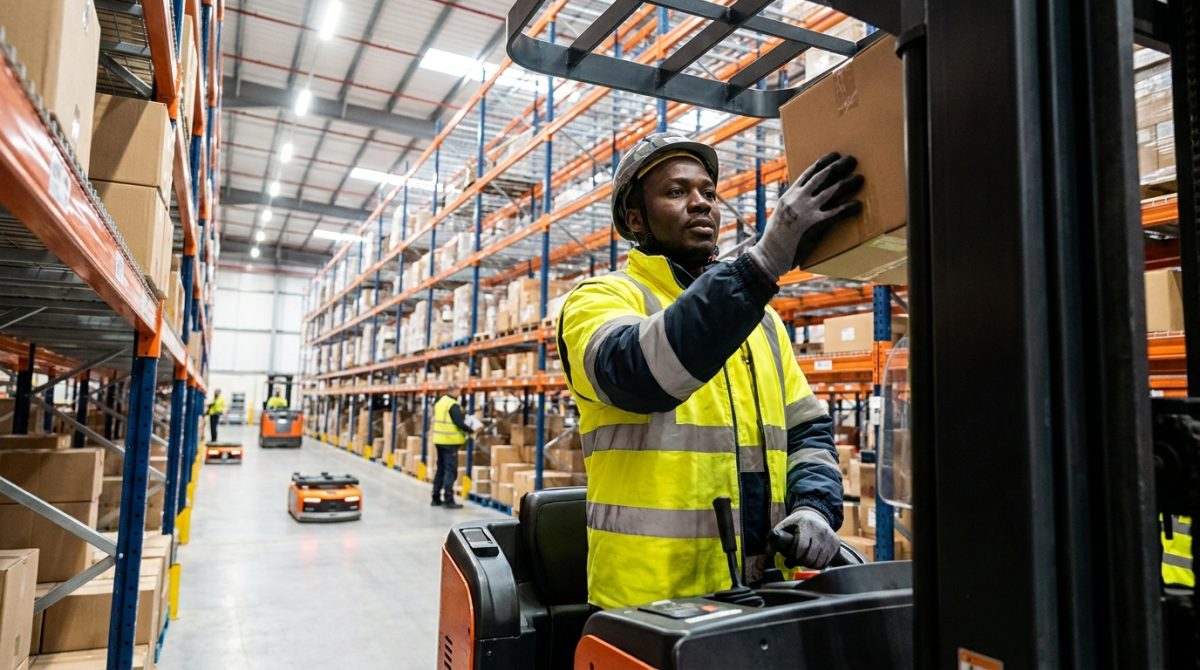
Warehouse and factory jobs in Poland with work visa sponsorship are the most realistic European route for a Nigerian worker without qualifications. Poland has become a manufacturing and logistics hub for the whole European Union, and it hires non-EU workers at scale to staff it.
The pay is lower than Canada or New Zealand. What Poland offers instead is accessibility, volume, and a legal foothold inside the European Union.
Quick summary: Non-EU workers need a Type A work permit, applied for by the employer at the regional Voivodeship office through praca.gov.pl — digital submission only since August 2025. A labour market test applies. Legal processing target is 30 days, though 1–3 months is realistic. You then apply for a national D visa at a Polish consulate. Wages typically run PLN 4,700–7,000 gross per month.
Why Poland Hires Non-EU Workers
Poland’s economy has grown for three decades and its manufacturing and logistics sectors now serve customers across the EU. At the same time, millions of Polish workers moved west after EU accession, and the domestic workforce is ageing.
The result is a sustained labour shortage in warehousing, production and logistics that Poland fills through non-EU recruitment. Polish employers are experienced at this, and the permit system is designed for volume rather than exception.
What the Work Pays
| Role | Typical Gross Monthly (PLN) | Rough EUR Equivalent | Notes |
|---|---|---|---|
| Warehouse picker / packer | 4,700–5,800 | €1,100–1,350 | Most common entry role |
| Forklift operator | 5,200–6,500 | €1,200–1,500 | Certification raises pay |
| Production line worker | 4,800–6,200 | €1,120–1,450 | Shift premiums common |
| Machine operator | 5,500–7,000 | €1,280–1,630 | Technical skill rewarded |
| Quality control | 5,200–6,800 | €1,200–1,580 | Attention to detail roles |
| Warehouse team leader | 6,500–8,500 | €1,500–1,980 | Progression role |
Be realistic about the arithmetic. Polish wages are well below Western European levels, and considerably below Canada or New Zealand. What makes them work is cost of living: rent, food and transport in Poland cost a fraction of London or Toronto, and many employers include accommodation.

How the Polish Work Permit Works
The structure matters, because it determines who does what.
- You secure a job offer from a Polish employer.
- The employer applies for your Type A work permit at the Voivodeship office covering the region where you will work. Since August 2025 this must be submitted digitally through praca.gov.pl.
- A labour market test applies — the employer must show no suitable Polish or EU worker is available.
- The Voivode issues the permit, with a legal target of 30 days but often taking one to three months in busy regions.
- You apply for a national D visa at the Polish consulate with the permit decision.
- The employer uploads your signed employment contract to the same portal before you start work.
- After arrival you may apply for a temporary residence and work permit (the single permit) to extend your stay.
The employer applies for the permit, not you. This is the single most useful fact for spotting fraud. If an agent claims they can obtain your Polish work permit directly, or asks you to pay for one, they are describing something the system does not allow. The permit application is filed by the employer, in Poland, through a government portal.
Requirements and Documents
- A genuine job offer from a Polish employer willing to apply for your permit.
- Valid international passport with adequate remaining validity.
- The Type A work permit decision issued by the Voivode.
- Employment contract matching the permit terms.
- Health insurance covering your stay.
- Proof of accommodation in Poland.
- Proof of funds for the initial period.
- Clean criminal record documentation where requested.
- Basic English is usually sufficient for warehouse and production work; Polish is not typically required to start.
The EU Dimension — and Its Limits
Working legally in Poland places you inside the European Union, and that has real value. But it is widely misrepresented, so be precise about what it does and does not give you.
| What People Assume | The Actual Position |
|---|---|
| You can work anywhere in the EU | No. Your permit is valid for Poland and a specific employer |
| You can travel freely in Schengen | Generally yes for short visits, but not to work |
| You get EU citizenship quickly | No. Polish citizenship takes many years of residence |
| You can bring family immediately | Family reunification has separate requirements |
| Long-term EU residence is possible | Yes, after continuous legal residence — typically 5 years |
Your Rights as a Worker in Poland
- Polish minimum wage applies and is set nationally each year.
- Written employment contract is required, matching your permit.
- Social insurance (ZUS) contributions give access to healthcare and benefits.
- Paid annual leave under the Polish Labour Code.
- Working time limits and overtime pay are regulated.
- Workplace safety protections apply regardless of nationality.
- Your passport stays with you — no employer may hold it.
The permit ties you to one employer. Changing jobs generally requires a new permit application by the new employer, so understand that before accepting a role you are unsure about.
Mistakes to Avoid
- Paying an agent for a Polish work permit. The employer files it; you cannot buy one.
- Believing an EU work permit lets you work across Europe. It does not.
- Accepting an offer with no written contract matching the permit terms.
- Not checking accommodation costs. Deductions can consume much of a Polish wage.
- Underestimating processing time. Plan for one to three months on the permit alone.
- Overstaying a Schengen visa hoping to regularise later. It rarely works and damages future applications.
- Ignoring the ZUS registration. Your social insurance is what gives you healthcare.
Frequently Asked Questions
Can Nigerians get warehouse jobs in Poland with visa sponsorship?
Yes. Poland issues Type A work permits to non-EU nationals including Nigerians. Your employer applies for the permit at the regional Voivodeship office, and you then apply for a national D visa at a Polish consulate.
Who applies for the work permit?
Your employer, digitally through praca.gov.pl since August 2025. You cannot apply for a Type A permit yourself, and nobody can sell you one.
How much do warehouse workers earn in Poland?
Typically PLN 4,700 to 5,800 gross per month for picking and packing, rising to PLN 5,200 to 6,500 for forklift operators. Machine operators and team leaders earn more.
How long does the process take?
The legal target for the work permit is 30 days, but one to three months is realistic in busy regions. Add time for the D visa application at the consulate.
Do I need to speak Polish?
Usually not for warehouse and production roles, where basic English is often sufficient and many workplaces are multinational. Learning Polish improves your prospects considerably over time.
Does working in Poland let me work anywhere in the EU?
No. A Polish work permit is valid for Poland and for the employer named on it. You may generally travel within the Schengen area for short visits, but not to work.
Can I bring my family?
Family reunification is possible but has separate requirements including income and accommodation thresholds. It is not automatic and not immediate.
Is accommodation provided?
Many Polish employers hiring non-EU workers provide or subsidise accommodation, often shared. Confirm the cost and any deductions in writing, because it significantly affects your take-home pay.
Can I change employers in Poland?
Not freely. Your Type A permit is tied to a specific employer and role, so a change generally requires a new permit application by the new employer.
Can this lead to permanent residence?
EU long-term resident status generally becomes possible after five years of continuous legal residence, and Polish permanent residence has its own criteria. It is a long path rather than a quick one.
Final Word
Poland is the most accessible European destination for a Nigerian worker without qualifications, and the permit system is built for volume rather than exception. Wages are modest by Western standards but so are costs, and accommodation is frequently included.
The one fact that protects you is structural: your employer files the permit, through a Polish government portal, in Poland. Anyone offering to sell you that permit is describing a process that does not exist.
This article is general information, not legal advice. Immigration rules change frequently — confirm current requirements with Polish authorities and the Polish consulate before acting. See our Disclaimer.