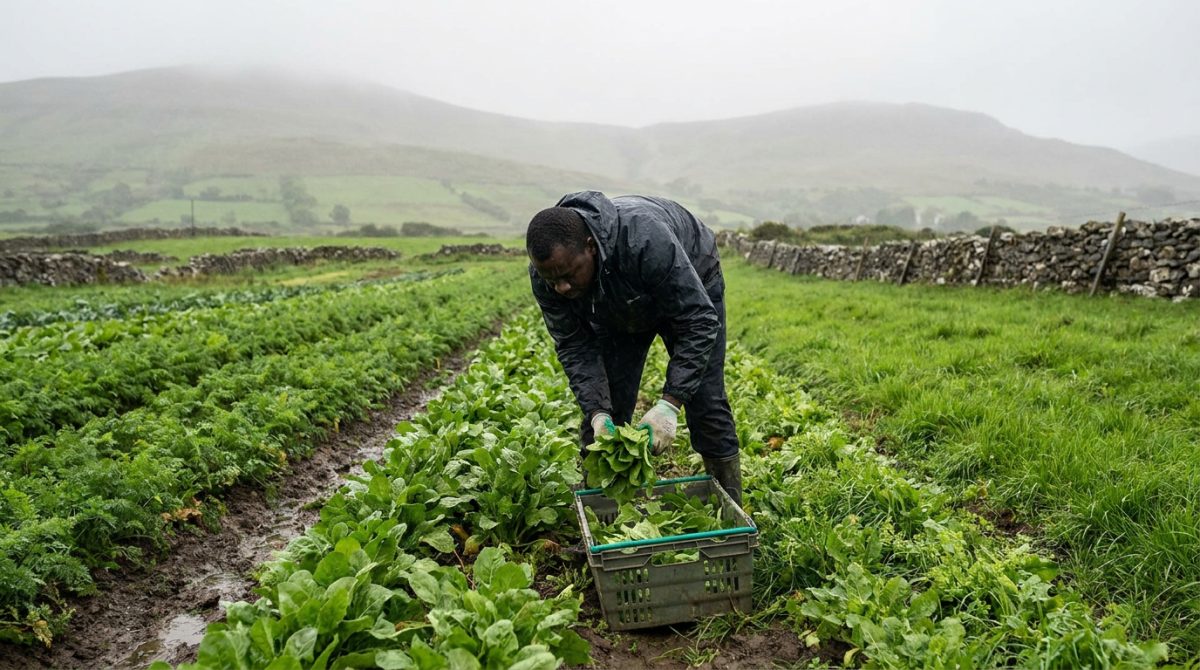
Jobs in Ireland with employment permit sponsorship are among the most overlooked opportunities available to Nigerian workers. Ireland is an English-speaking EU member state that issues quota-based permits specifically for occupations that sit below the normal skills threshold — which is exactly the category most other countries have been closing.
While the UK shut its care route and raised its skill bar to degree level, Ireland went the other way and expanded quotas for agricultural and food processing workers.
Quick summary: Non-EEA workers need a General Employment Permit, applied for through the Department of Enterprise, Tourism and Employment. Ireland operates occupation-specific quotas, including permits for horticulture operatives, meat processing operatives, meat deboners and dairy farm assistants. Healthcare assistants and home support workers are also eligible. The minimum salary for these roles rises to €32,691. English is the working language. Verify at enterprise.gov.ie.
Why Ireland Is Different
Most developed countries responded to political pressure by restricting lower-skilled migration. Ireland’s agri-food sector — beef, dairy, horticulture — is central to its economy and concentrated in rural areas with full employment and no available domestic labour.
Rather than let processing plants and farms run short, Ireland created ring-fenced quotas for specific occupations. These are not loopholes. They are deliberate government allocations, published, numbered and reviewed annually.
Combine that with English as the working language, EU membership, and a route to long-term residence, and Ireland becomes one of the strongest options available to a Nigerian worker without qualifications.
Quota Occupations and What They Pay
| Occupation | Permit Route | Minimum Salary | Sector |
|---|---|---|---|
| Horticulture operative | General Employment Permit (quota) | €32,691 | Fruit, vegetable, mushroom growing |
| Meat processing operative | General Employment Permit (quota) | €32,691 | Beef and poultry plants |
| Meat deboner | General Employment Permit (quota) | €32,691 | Skilled knife work |
| Dairy farm assistant | General Employment Permit (quota) | €32,691 | Milking and herd work |
| Healthcare assistant | General Employment Permit | €32,691 | Nursing homes, hospitals |
| Home support worker | General Employment Permit | €32,691 | Community care |
| Chef | General Employment Permit | Varies by grade | Hospitality |
Note what that salary figure means in context. €32,691 is dramatically higher than Polish or Romanian factory pay, and it is a legal minimum rather than an average. Ireland is not a low-wage destination.

How the Employment Permit Works
- You secure a job offer from an Irish employer for an eligible occupation.
- Check the quota position — if the annual allocation for that occupation is exhausted, applications wait for the next round.
- A labour market needs test generally applies, requiring the employer to have advertised the role domestically and across the EEA.
- The permit application is submitted to the Department of Enterprise, Tourism and Employment. Either you or your employer can apply, unlike Poland where only the employer can.
- The permit is issued naming you, the employer and the role.
- You apply for a long-stay D visa at the Irish visa office serving Nigeria.
- You travel and register with immigration after arrival to obtain your residence permission.
The quota is the thing to check first. Ireland publishes how many permits are available for each quota occupation each year. When an allocation is used up, no further permits are issued for that occupation until the next allocation — regardless of how strong your application is. Any agent who does not mention quotas is either uninformed or not being straight with you.
Requirements and Documents
- A genuine job offer for an eligible occupation from an Irish employer.
- Salary meeting the threshold for your occupation.
- Valid international passport.
- Employment contract signed by both parties.
- Evidence of relevant experience or qualifications where required.
- Permit application fee.
- Long-stay D visa application after the permit is granted.
- Police clearance and supporting documents as requested.
Why Ireland Compares Well
| Factor | Ireland | Poland / Romania | UK |
|---|---|---|---|
| Working language | English | Polish / Romanian | English |
| Minimum salary | €32,691 | Far lower | Varies by route |
| Accessible occupations | Quota permits available | Broad but low paid | Mostly closed |
| EU membership | Yes | Yes | No |
| Family reunification | Possible | Possible | Restricted on some routes |
| Long-term residence | After qualifying period | After 5 years | After 5 years |
Your Rights as a Worker in Ireland
- National minimum wage and sectoral employment orders apply.
- Written terms of employment must be provided.
- Paid annual leave and public holidays under Irish employment law.
- PRSI social insurance giving access to benefits and healthcare entitlements.
- Workplace safety protections regardless of nationality.
- Workplace Relations Commission handles complaints, including from permit holders.
- Your passport stays with you at all times.
After a qualifying period on employment permits, workers may become eligible to apply for permission that is no longer tied to a single employer, and eventually for long-term residence. This progression is one of Ireland’s genuine advantages over purely temporary routes.
Mistakes to Avoid
- Not checking the quota before investing time in an application.
- Paying an agent for a permit. Fees are payable to the Department, not to intermediaries.
- Accepting a salary below the threshold. The application will fail.
- Assuming an Irish permit covers other EU countries. It does not.
- Applying for an occupation not on the eligible list. Many roles are specifically excluded.
- Ignoring the labour market needs test requirement on the employer’s side.
- Overlooking healthcare assistant roles, which are eligible and in sustained demand.
Frequently Asked Questions
Can Nigerians get jobs in Ireland with employment permit sponsorship?
Yes. Ireland issues General Employment Permits to non-EEA nationals including Nigerians, with specific quotas for horticulture operatives, meat processing operatives, meat deboners and dairy farm assistants, plus eligibility for healthcare assistants and home support workers.
What is the minimum salary?
The minimum for these quota and care occupations rises to €32,691. That is a legal floor, not an average, and is substantially higher than Polish or Romanian equivalents.
What are the quotas?
Ireland allocates a fixed number of permits per occupation each year — recent allocations have included figures such as 1,000 horticulture operatives, 500 meat deboners and 1,500 meat processing operatives, alongside dairy farm assistant allocations. Check current numbers before applying, because allocations can be exhausted.
Do I need to speak another language?
No. English is the working language of Ireland, which removes the main practical barrier that Poland and Romania present.
Who applies for the permit?
Either you or your employer may submit the employment permit application in Ireland, which differs from Poland where only the employer can apply.
Is there a labour market test?
Generally yes. The employer must usually show the role was advertised in Ireland and across the EEA before a General Employment Permit is granted.
Can I bring my family?
Family reunification is possible under Irish rules, subject to conditions including income requirements. It is not automatic or immediate.
Does an Irish permit let me work elsewhere in the EU?
No. It is valid for Ireland and the employer named on it. Note also that Ireland is not part of the Schengen area, so travel rules differ from most EU states.
Can this lead to permanent residence?
After a qualifying period on employment permits, workers may become eligible for permission not tied to a single employer, and in time for long-term residence. This progression is a genuine advantage over temporary seasonal routes.
How does Ireland compare to the UK?
For accessible occupations, Ireland is now considerably more open. The UK closed care worker sponsorship to overseas applicants and raised its skill threshold to degree level, while Ireland maintains quota permits specifically for lower-skilled agri-food and care roles.
Final Word
Ireland deserves far more attention than it gets from Nigerian applicants. It is English-speaking, inside the EU, pays a legal minimum well above Eastern European wages, and deliberately allocates permits to exactly the occupations most countries have closed off.
The one discipline this route demands is timing. Check the quota position for your occupation before you commit to anything, because when an allocation is exhausted, the strength of your application makes no difference at all.
This article is general information, not legal advice. Quotas, salary thresholds and eligible occupation lists change annually — confirm current requirements at enterprise.gov.ie before acting. See our Disclaimer.