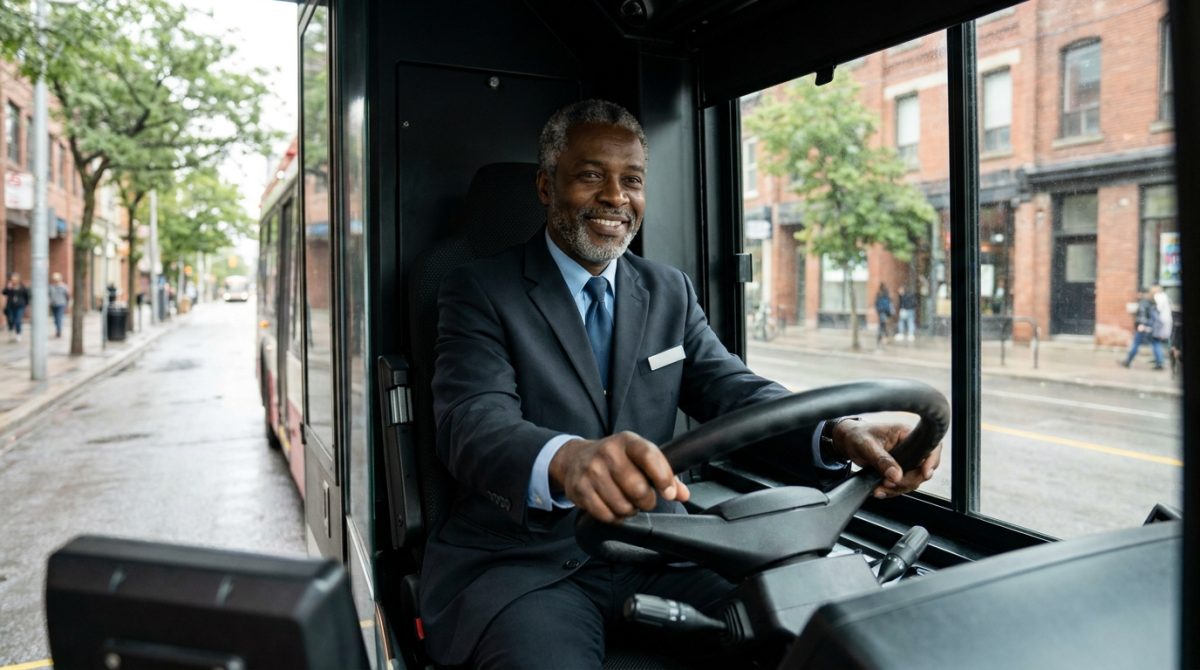
Bus and delivery driver jobs in Canada with visa sponsorship are among the most underrated accessible routes available, for one reason that most applicants miss: bus driving is classified at TEER 3, which puts it in the same permanent residence bracket as skilled trades — while requiring no degree and no apprenticeship.
If you can drive, and you can pass a Canadian licence test, this is a stronger immigration position than cleaning, hospitality or warehouse work.
Quick summary: Bus drivers are NOC 73301 (TEER 3), delivery and courier drivers NOC 75201 (TEER 5). Sponsorship runs through an employer LMIA. Wages run CAD $22–38 per hour for transit driving. TEER 3 qualifies for the Canadian Experience Class after one year of Canadian work. You will need a Canadian commercial licence obtained after arrival. Verify on Job Bank.
Why Canada Sponsors Foreign Drivers
Canadian transit authorities, school bus operators and motorcoach companies have faced sustained driver shortages. The work involves split shifts, early mornings and considerable responsibility, and domestic recruitment has not kept pace with retirements.
School bus operators in particular struggle, because the hours suit almost nobody — a few hours morning and afternoon, with a gap in between. Municipal transit and intercity coach operators face similar pressures on unsociable routes.
The Classification That Changes Everything
| Role | NOC Code | TEER | Typical Wage (CAD) | PR Access |
|---|---|---|---|---|
| Transit bus driver | 73301 | TEER 3 | $26–38 / hour | Strong — CEC eligible |
| School bus driver | 73301 | TEER 3 | $22–30 / hour | Strong — CEC eligible |
| Motorcoach / intercity driver | 73301 | TEER 3 | $25–36 / hour | Strong |
| Long-haul truck driver | 73300 | TEER 3 | $55,000–90,000 / year | Strong |
| Delivery / courier driver | 75201 | TEER 5 | $17–24 / hour | Limited |
| Taxi / rideshare driver | 73302 | TEER 4 | Variable | Limited |
| Transit supervisor | 72024 | TEER 2 | $32–45 / hour | Strong |
Read the first and fifth rows together. A bus driver and a delivery driver both drive for a living. One is TEER 3 and qualifies for the Canadian Experience Class after a year. The other is TEER 5 and does not. That single classification difference is worth more to your future than any wage gap.
If you are choosing between driving roles in Canada, choose the bus.

The Licensing Reality
As with truck driving, you cannot drive a Canadian bus on a Nigerian licence. You will need a provincial commercial licence with the appropriate class and endorsements.
- Class 2 (or provincial equivalent) is generally required for buses.
- Air brake endorsement is commonly needed.
- School bus operation requires additional certification and a criminal record check including vulnerable sector screening.
- Medical examination to commercial driving standards.
- Clean driving abstract from your licensing authority.
Most sponsoring employers train and license you after arrival. Transit authorities and school bus operators frequently run their own licensing programmes because they cannot recruit pre-licensed drivers in the numbers they need. Ask explicitly what training is funded — and treat any agent selling you a “Canadian bus licence” from Nigeria as fraudulent, because licensing happens in Canada.
Visa Requirements
- A genuine job offer from a Canadian operator with a positive LMIA.
- Commercial or professional driving experience, documented in reference letters.
- Clean driving record — scrutinised closely for passenger transport.
- Strong English — you will interact with passengers constantly.
- Police clearance certificates, with vulnerable sector screening for school transport.
- Medical examination to commercial standards.
- Valid international passport.
Passenger-facing English matters more here than in most accessible roles. Bus drivers answer questions, handle fare disputes, manage incidents and communicate with dispatch. Employers screen for it seriously.
Permanent Residence Pathways
| Programme | Bus Driver (TEER 3) | Delivery Driver (TEER 5) |
|---|---|---|
| Canadian Experience Class | Yes — after 1 year | No |
| Provincial Nominee Program | Yes — widely listed | Some semi-skilled streams |
| Rural Community Immigration Pilot | Yes | Yes, participating communities |
| Atlantic Immigration Program | Yes | Yes, designated employers |
| Express Entry (FSW) | Possible | No |
Settlement Benefits and Your Rights
| Benefit | On a Work Permit? | With PR? | Notes |
|---|---|---|---|
| Union membership | Often | Often | Municipal transit is heavily unionised |
| Employer-funded licence training | Commonly | — | Ask what is covered |
| Public healthcare | Usually yes | Yes | Provincial |
| Free public schooling | Yes | Yes | Dependent children |
| Spousal open work permit | Often yes at TEER 3 | Yes | Better than TEER 5 roles |
| Pension plan | Common in transit | Common | Municipal employers offer strong plans |
| Workers’ compensation | Yes | Yes | Mandatory |
| Path to citizenship | No | Yes | After three years of physical presence in five |
Municipal transit is one of the better-unionised sectors open to sponsored workers in Canada, which typically means negotiated wage scales, pension contributions and grievance protection — all valuable when your permit is tied to one employer.
Mistakes to Avoid
- Taking delivery driving when bus driving is available. TEER 5 versus TEER 3 decides your PR options.
- Buying a “Canadian bus licence” abroad. Licensing happens in Canada.
- Underestimating the English requirement. Passenger contact is constant.
- Hiding driving convictions. Records are checked thoroughly for passenger transport.
- Not asking who funds licence training. Many employers pay; get it in writing.
- Overlooking school bus work because of split shifts — it is often the easiest entry point.
- Paying an agent for a job offer. The LMIA is the employer’s cost.
How to Apply
- Search Job Bank for NOC 73301 roles open to LMIA candidates.
- Apply directly to municipal transit authorities, school bus operators and motorcoach companies.
- Document your professional driving experience in detail — vehicle types, passenger numbers, years.
- Obtain your Nigerian driving abstract early.
- Confirm in writing what licence training the employer funds.
- Apply for the work permit through the IRCC secure account.
- Complete biometrics and the commercial medical.
- On arrival, obtain your provincial licence and begin building toward the Canadian Experience Class.
Frequently Asked Questions
Can Nigerians get bus driver jobs in Canada with visa sponsorship?
Yes. Bus driving is NOC 73301 at TEER 3 and can be sponsored through an employer LMIA. You will need to obtain a Canadian provincial commercial licence after arrival, which many employers fund.
Why is bus driving better than delivery driving for immigration?
Bus driver is TEER 3, which qualifies for the Canadian Experience Class after one year of Canadian work. Delivery and courier driving is TEER 5, which does not. Both involve driving; only one leads to a straightforward permanent residence route.
How much do bus drivers earn in Canada?
Transit drivers typically earn CAD $26 to $38 per hour, school bus drivers $22 to $30, and motorcoach drivers $25 to $36. Municipal transit roles often include pensions and union benefits.
Can I drive on my Nigerian licence?
No. You need a provincial commercial licence with appropriate class and endorsements, obtained in Canada. Anyone offering to sell you a Canadian bus licence from Nigeria is defrauding you.
Will the employer pay for my licence training?
Frequently yes. Transit authorities and school bus operators often run their own licensing programmes because they cannot recruit enough pre-licensed drivers. Confirm in writing what is covered.
Do I need strong English?
Yes, more than in most accessible roles. Drivers deal with passengers, fares, incidents and dispatch communication constantly, and employers screen for it.
What extra checks apply to school bus driving?
Additional certification and enhanced criminal record screening including vulnerable sector checks, because you are transporting children.
Can bus drivers get permanent residence?
Yes. TEER 3 qualifies for the Canadian Experience Class after one year of Canadian work, and bus driving appears on several provincial nominee occupation lists.
Can I bring my family?
At TEER 3 your position is considerably better than in TEER 5 roles. Spousal open work permits are often available and dependent children attend public school.
Are school bus split shifts a problem?
They suit few local workers, which is exactly why the roles are hard to fill and open to sponsorship. Many drivers combine school runs with charter or transit work to build full hours.
Final Word
Bus driving is the quiet outlier among accessible Canadian occupations. It needs no degree, no apprenticeship and no trade ticket — only the ability to drive well, communicate clearly and pass a Canadian licence test that your employer will often pay for.
And it sits at TEER 3, which places it alongside skilled trades for permanent residence purposes. If you are weighing accessible driving work in Canada, that classification should decide it.
This article is general information, not legal advice. Immigration and provincial licensing rules change frequently — confirm all requirements on canada.ca and with your provincial licensing authority before acting. See our Disclaimer.