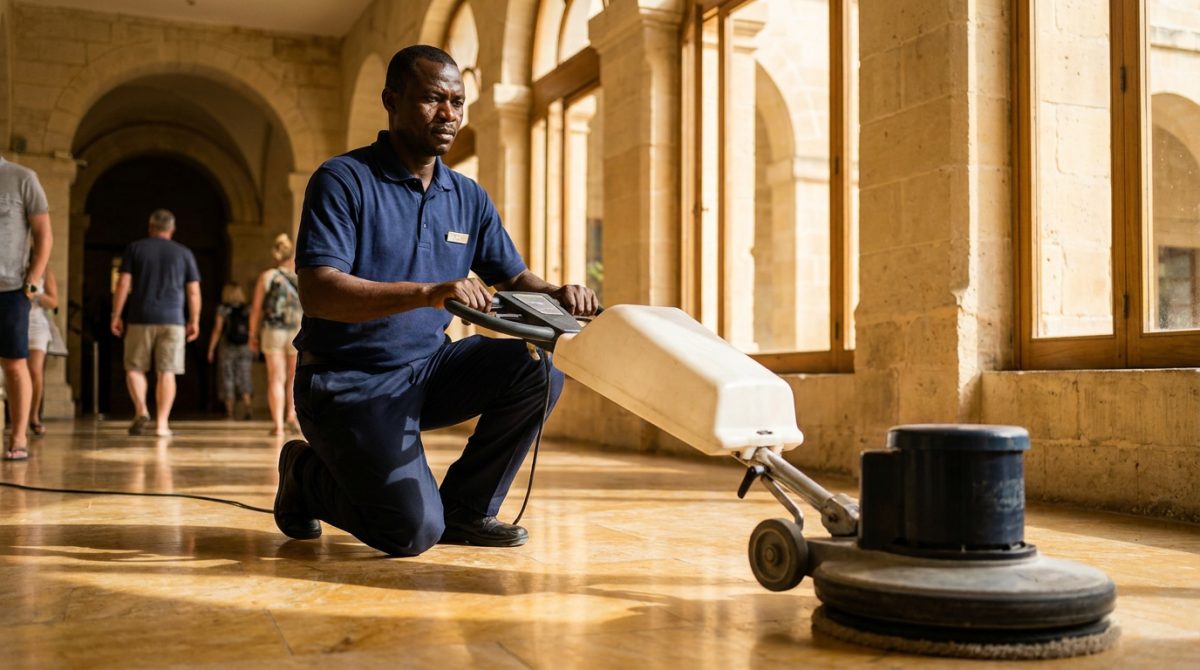
Cleaning and hospitality jobs in Malta with visa sponsorship occupy an unusual position in European migration: a small English-speaking EU member state with a tourism industry far larger than its population can staff, which has spent years recruiting third-country nationals to fill the gap.
For a Nigerian applicant, Malta’s advantage over Poland or Romania is straightforward — English is an official language, which removes the biggest practical barrier to settling in continental Europe.
Quick summary: Third-country nationals need a Single Permit combining work and residence authorisation, applied for through Identità Malta with the employer’s involvement. Malta’s minimum wage and hospitality sector wages are low by Western European standards, typically €950–1,400 gross per month for cleaning and hospitality roles. English is an official language alongside Maltese. Confirm at identita.gov.mt.
Why Malta Recruits Foreign Workers
Malta has a population of roughly half a million and receives several million tourists a year. Hotels, restaurants, cleaning contractors and facilities companies simply cannot staff that ratio from the domestic labour force, and Maltese workers have moved toward better-paid financial services and gaming sectors.
The result is that a substantial share of Malta’s hospitality and cleaning workforce consists of third-country nationals, and employers are highly experienced at sponsoring them.
What the Work Pays
| Role | Typical Gross Monthly (EUR) | Notes |
|---|---|---|
| Cleaner (commercial) | €950–1,200 | Offices, common areas |
| Hotel housekeeper | €1,000–1,300 | Peak season overtime available |
| Kitchen porter | €1,000–1,250 | Entry hospitality role |
| Waiter / bar staff | €1,050–1,400 | Tips supplement in tourist areas |
| Housekeeping supervisor | €1,300–1,700 | Progression role |
| Cook / chef de partie | €1,400–2,000 | Skilled kitchen role |
| Care worker | €1,100–1,500 | Growing sector |
Accommodation is Malta’s real problem, not the wage. Rents have risen sharply and shared accommodation can consume a large share of a hospitality salary. Before accepting any Malta offer, establish exactly what you will pay for housing and whether the employer provides or subsidises it. A €1,100 salary with €500 rent is a very different proposition from the same salary with accommodation included.
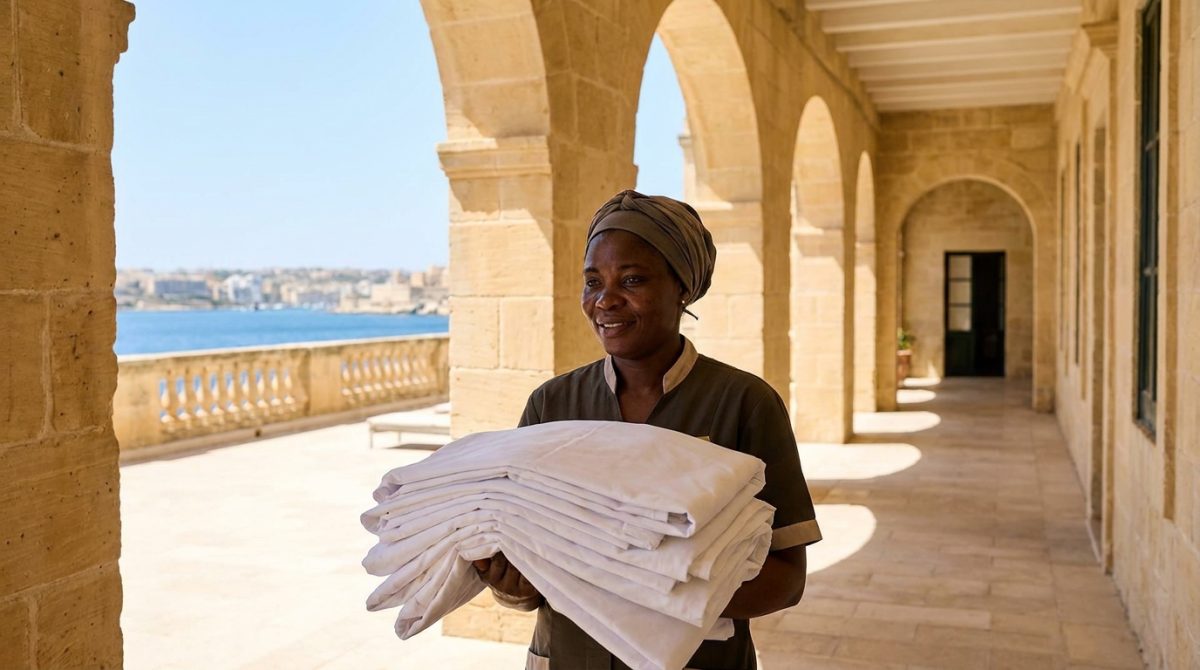
How the Single Permit Works
Malta uses a Single Permit — one application covering both the right to work and the right to reside, rather than separate permits.
- You secure a job offer from a Maltese employer.
- The employer initiates the Single Permit application through Identità Malta, including a labour market consideration.
- Documents are submitted covering your identity, qualifications, health and the employment contract.
- An approval in principle may be issued, allowing you to apply for an entry visa where required.
- You travel to Malta and complete biometric enrolment.
- The residence card is issued, permitting work with the named employer.
- Renewal is required periodically and depends on continued employment.
The permit ties you to the employer. Changing jobs requires a new application, so treat your first employer choice as consequential rather than provisional.
Requirements and Documents
- A genuine job offer from a Maltese employer willing to sponsor.
- Valid international passport.
- Signed employment contract meeting Maltese minimum standards.
- Proof of accommodation in Malta.
- Health insurance until you enter the Maltese system.
- Police conduct certificate from Nigeria.
- Qualification documents where relevant to the role.
- Passport photographs to specification.
The English Advantage
This is the genuine differentiator and it deserves emphasis. Malta has English as an official language alongside Maltese. Government services, employment contracts, healthcare and daily commerce all operate in English.
Compare that to Poland or Romania, where a Nigerian worker faces a language barrier that limits progression, complicates official processes and slows integration. In Malta you can read your own employment contract, understand your payslip, deal with authorities directly and progress into customer-facing roles without a language qualification.
For anyone weighing European destinations, this single factor often matters more than a few hundred euro of gross salary.
Your Rights as a Worker in Malta
| Right | Position |
|---|---|
| National minimum wage | Applies regardless of nationality |
| Statutory bonuses | Paid quarterly on top of wages |
| Paid annual leave | Full entitlement under Maltese law |
| Public holidays | Additional entitlement |
| Social security | Contributions give healthcare access |
| Overtime | Regulated and payable |
| Passport | Stays in your possession |
| Change employer | Requires a new permit application |
Long-Term Prospects
| Stage | Position |
|---|---|
| Single Permit | Work and residence with one employer |
| Renewal | Tied to continued employment |
| EU long-term residence | Generally after five years of continuous legal residence |
| Maltese citizenship | Long naturalisation period; strict criteria |
| Family reunification | Possible with income and accommodation conditions |
Mistakes to Avoid
- Ignoring accommodation costs. Malta’s rents can consume most of a hospitality wage.
- Paying an agent for a Single Permit. The employer initiates it.
- Assuming EU-wide work rights. The permit covers Malta only.
- Treating the first employer as temporary. Changing jobs requires a new permit.
- Overlooking the statutory bonus system when comparing offers.
- Not confirming the contract meets Maltese minimum standards.
- Underestimating summer workload. Tourist season is intense.
Frequently Asked Questions
Can Nigerians get cleaning and hospitality jobs in Malta with visa sponsorship?
Yes. Malta relies heavily on third-country nationals in hospitality and cleaning, and employers are experienced sponsors. You need a job offer and a Single Permit application initiated by that employer.
Is English enough to work in Malta?
Yes. English is an official language of Malta, used in government, healthcare, contracts and commerce. This is Malta’s single biggest advantage over Poland or Romania for Nigerian applicants.
How much do cleaners and hospitality staff earn?
Typically €950 to €1,400 gross per month depending on role, plus statutory quarterly bonuses. Supervisory and skilled kitchen roles pay more.
What is the Single Permit?
One authorisation covering both work and residence, issued through Identità Malta, rather than separate work and residence permits. It is tied to your employer.
Is accommodation provided?
Some employers provide or subsidise it, but many do not. Given Malta’s high rents relative to hospitality wages, this is the most important question to settle before accepting an offer.
Can I change employers in Malta?
Not freely. Your Single Permit is tied to a specific employer, so a change requires a new application.
Does working in Malta let me work elsewhere in the EU?
No. The permit is valid for Malta only. EU long-term resident status after five years of continuous legal residence provides broader options.
Can I bring my family?
Family reunification is possible subject to income and accommodation requirements. It is not automatic.
What are the working conditions like?
Maltese hospitality is intensely seasonal, with a demanding summer peak. Employment law protections apply fully, including paid leave, public holidays and regulated overtime.
Is Malta better than Poland for Nigerians?
Malta pays comparably or slightly better and operates in English, which is a substantial practical advantage. Poland has a larger job market and lower living costs. Compare specific offers including accommodation rather than the countries in general.
Final Word
Malta is the most linguistically accessible EU destination for Nigerian workers, and its tourism economy genuinely depends on foreign labour. English-language daily life removes a barrier that shapes everything in Poland or Romania.
The trade-off is housing. Establish precisely what accommodation will cost before you accept anything, because on a hospitality salary in Malta, that single number determines whether the move works.
This article is general information, not legal advice. Immigration rules change frequently — confirm current requirements with Identità Malta before acting. See our Disclaimer.