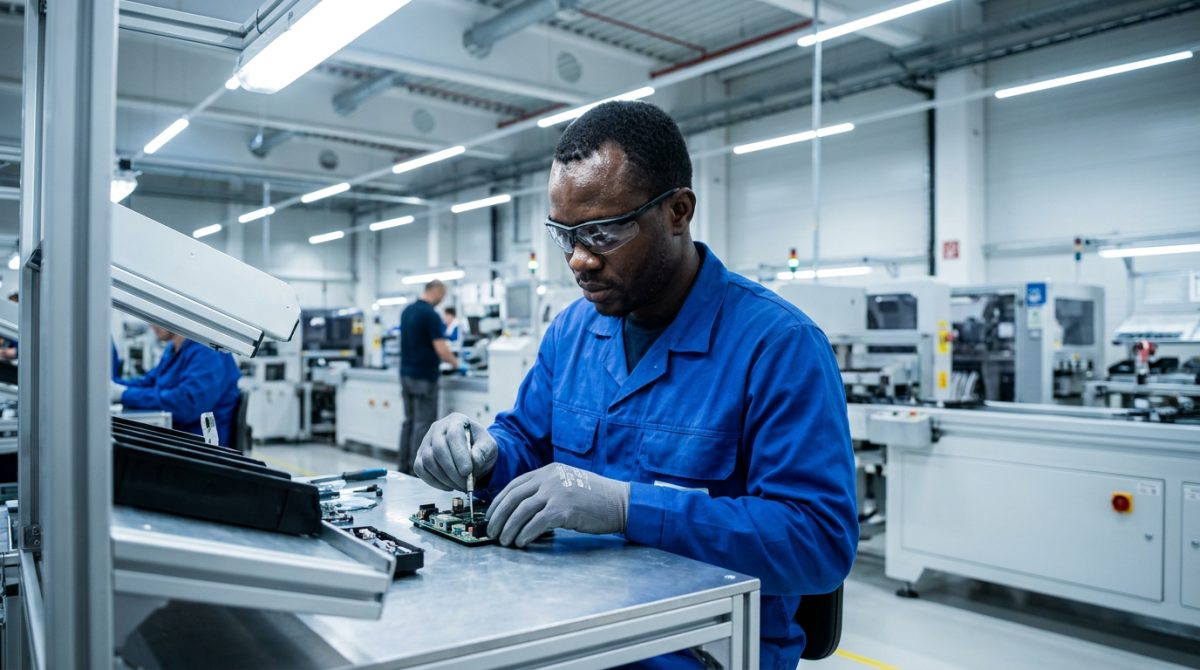
Factory jobs in Romania with work visa sponsorship have grown steadily as automotive and electronics manufacturers moved production into the country. Romania now issues tens of thousands of work permits to non-EU nationals each year, and its recruitment channels into Asia and Africa are well established.
Wages are the lowest of any destination covered on this site. What Romania offers is a comparatively straightforward permit process and a legal position inside the European Union.
Quick summary: Non-EU workers need an employment work permit (aviz de angajare), applied for by the employer at the General Inspectorate for Immigration (IGI). Romania sets an annual quota for non-EU work permits. You then apply for a long-stay D/AM visa at a Romanian consulate, and a residence permit after arrival. Wages typically run RON 3,700–5,500 gross per month. Confirm at igi.mai.gov.ro.
Why Romania Recruits Non-EU Workers
Romania’s manufacturing base expanded rapidly after EU accession, particularly in automotive components, electronics and consumer goods. At the same time several million Romanians moved to Western Europe for higher wages, leaving a domestic shortage that grows every year.
Romania responded by raising its annual quota for non-EU work permits substantially and by simplifying employer procedures. The country now has established recruitment pipelines from South and Southeast Asia, and increasingly from Africa.
What the Work Pays
| Role | Typical Gross Monthly (RON) | Rough EUR Equivalent | Notes |
|---|---|---|---|
| Production line worker | 3,700–4,600 | €740–925 | Most common entry role |
| Automotive assembly worker | 4,000–5,200 | €800–1,045 | Largest employing sector |
| Warehouse operative | 3,700–4,800 | €740–965 | Logistics growth area |
| Machine operator | 4,200–5,500 | €845–1,105 | Technical skill rewarded |
| Welder | 4,500–6,000 | €905–1,205 | Skilled trade premium |
| Quality inspector | 4,200–5,400 | €845–1,085 | Detail-focused roles |
Be clear-eyed about the wages. Romanian factory pay is roughly a third of Canadian equivalents and well below Poland. It works for some people because living costs are correspondingly low and accommodation is usually provided — but anyone presenting Romania as a high-earning destination is misleading you. Judge it as a legal EU foothold with modest pay, not as a way to send large remittances home.

How the Romanian Work Permit Works
- You secure a job offer from a Romanian employer.
- The employer applies for the work permit (aviz de angajare) at the General Inspectorate for Immigration, having advertised the role domestically.
- The application counts against Romania’s annual quota for non-EU workers.
- The permit is issued to the employer, who sends it to you.
- You apply for a long-stay work visa (D/AM) at a Romanian consulate.
- You travel to Romania and begin work under contract.
- You apply for a residence permit at the local immigration office within the required period after arrival.
The quota matters. Romania caps the number of non-EU work permits issued annually. When the quota fills, applications wait for the next allocation, which is a common cause of delay that has nothing to do with your individual application.
Requirements and Documents
- A genuine job offer from a Romanian employer willing to apply for your permit.
- Valid international passport with adequate remaining validity.
- The work permit (aviz) obtained by your employer.
- Employment contract matching the permit terms.
- Medical certificate confirming fitness to work.
- Criminal record certificate from Nigeria.
- Proof of accommodation in Romania.
- Health insurance and proof of funds.
- Qualification documents where the role requires them.
The EU Position — Stated Accurately
| Common Claim | Actual Position |
|---|---|
| A Romanian permit lets you work across the EU | No. Valid for Romania and your named employer |
| Romania is in Schengen | Romania joined Schengen for air and sea borders in 2024, with land borders following — confirm current status |
| You can move to Germany after a year | No. Moving requires meeting that country’s own requirements |
| Quick route to EU citizenship | No. Romanian citizenship requires many years of residence |
| Long-term EU residence possible | Yes, generally after five years of continuous legal residence |
Your Rights as a Worker in Romania
- Romanian minimum wage applies, set nationally each year.
- Written employment contract registered with the authorities is mandatory.
- Social contributions give access to healthcare and pension entitlements.
- Paid annual leave under the Romanian Labour Code.
- Overtime regulation and working time limits apply.
- Workplace safety protections regardless of nationality.
- Your passport remains yours — no employer may retain it.
Mistakes to Avoid
- Paying an agent for a Romanian work permit. The employer applies; you cannot buy one.
- Expecting Western European wages. Romanian factory pay is modest.
- Assuming EU-wide work rights. The permit covers Romania only.
- Ignoring the quota. Delays are often systemic, not personal.
- Accepting undocumented work. Your contract must be registered.
- Not checking accommodation deductions against a low gross wage.
- Missing the residence permit deadline after arrival.
Frequently Asked Questions
Can Nigerians get factory jobs in Romania with visa sponsorship?
Yes. Romania issues work permits to non-EU nationals including Nigerians, subject to an annual quota. Your employer applies for the permit at the General Inspectorate for Immigration, and you then apply for a long-stay D/AM visa.
How much do factory workers earn in Romania?
Typically RON 3,700 to 5,200 gross per month for production and assembly work, with skilled trades such as welding reaching RON 6,000. These are modest wages by Western European standards.
Who applies for the work permit?
Your employer, at the General Inspectorate for Immigration. You cannot apply yourself and no agent can sell you a permit.
What is the quota?
Romania sets an annual limit on non-EU work permits. When it fills, further applications wait for the next allocation, which frequently causes delays unrelated to your own application.
Do I need to speak Romanian?
Usually not for factory and warehouse roles, where basic English often suffices and many plants are internationally owned. Romanian helps considerably for daily life and progression.
Does a Romanian permit let me work elsewhere in the EU?
No. It is valid for Romania and the employer named on it. Working in another EU country requires meeting that country’s own immigration requirements.
Is accommodation provided?
Commonly yes, often shared and arranged by the employer. Given the low gross wage, confirm exactly what is deducted before accepting an offer.
Can I bring my family?
Family reunification is possible but has separate income and accommodation requirements, and is not immediate.
Can this lead to permanent residence?
EU long-term resident status generally becomes available after five years of continuous legal residence. Romanian citizenship takes considerably longer.
Is Romania better than Poland?
Poland generally pays more and has a larger job market. Romania can have shorter permit processing in some periods. If both are options, compare the specific offers rather than the countries in the abstract.
Final Word
Romania is the most accessible European destination on wages alone — and the lowest paying. It suits applicants whose priority is obtaining legal EU work status and building toward long-term residence rather than maximising immediate earnings.
The protective fact is the same as Poland’s: your employer files the permit with the Romanian immigration authority. Anyone selling you a Romanian work permit directly is selling a process that does not exist.
This article is general information, not legal advice. Immigration rules and quotas change annually — confirm current requirements with Romanian authorities before acting. See our Disclaimer.