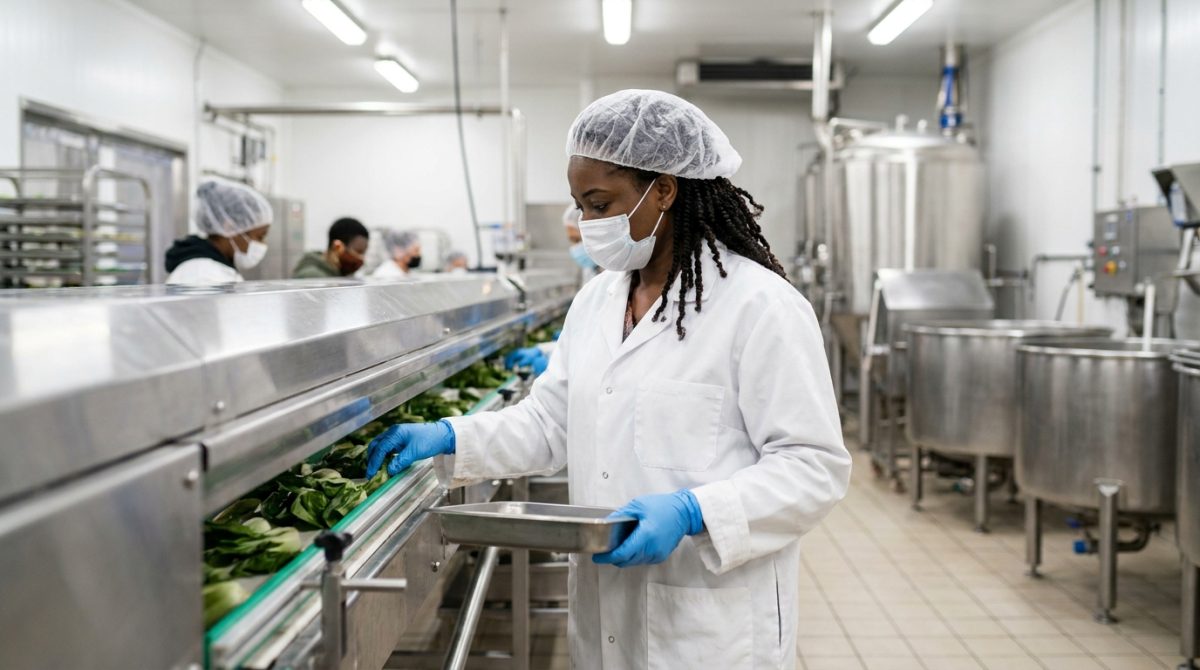
Food processing and meat packing jobs in Canada with visa sponsorship are, in immigration terms, the most underrated accessible route available to Nigerian applicants. The work is hard and cold. But the classification is better than cleaning or hospitality, and several provinces have built permanent residence streams specifically around this sector.
If your goal is not just to reach Canada but to stay, this is the category to understand properly.
Quick summary: Industrial butchers and meat cutters are NOC 94141, fish and seafood plant workers NOC 94142 — both TEER 4, a full step above general labouring. Sponsorship runs through an employer LMIA. Wages run CAD $18–28 per hour with shift premiums. Manitoba, Alberta and Saskatchewan operate PNP streams that explicitly accommodate food processing. Verify postings on Job Bank.
Why Canada Sponsors Foreign Food Plant Workers
Canadian meat and food processing plants are typically located in small prairie and rural towns with populations of a few thousand. The plants employ hundreds. The arithmetic simply does not work without foreign labour, and it has not worked for decades.
These employers are among the most experienced users of the Temporary Foreign Worker Program in Canada. They have dedicated immigration staff, established relationships with provincial nominee programmes, and a strong commercial interest in workers staying permanently rather than cycling out every two years.
That last point is the whole opportunity. Unlike a hotel that wants seasonal labour, a meat plant wants you to settle, because training a line worker takes months and turnover is expensive. Their interests and yours align.
Types of Food Processing Jobs Available With Sponsorship
| Role | NOC Code | TEER | Typical Wage (CAD) | PR Access |
|---|---|---|---|---|
| Industrial butcher / meat cutter | 94141 | TEER 4 | $19–28 / hour | Good — dedicated PNP streams |
| Fish and seafood plant worker | 94142 | TEER 4 | $18–25 / hour | Good — Atlantic focus |
| Poultry processing worker | 94141 | TEER 4 | $18–26 / hour | Good |
| Food and beverage processing labourer | 95106 | TEER 5 | $17–22 / hour | Limited |
| Process control operator | 94211 | TEER 3 | $22–33 / hour | Strong — CEC eligible |
| Quality control inspector | 92100 | TEER 2 | $24–36 / hour | Strong |
| Production supervisor | 92012 | TEER 2 | $28–42 / hour | Strong |
| Sanitation worker (plant) | 65312 | TEER 5 | $19–26 / hour | Limited |
Aim for NOC 94141, not 95106. Both are entry-level plant work. One is TEER 4 with dedicated provincial nominee streams; the other is TEER 5 with very little. The distinction is about whether you are classified as performing a specific trade task — cutting, boning, trimming — rather than general labouring. Ask employers to classify you accurately.
Visa Types for Food Processing Work
| Route | LMIA Required? | Duration | Notes |
|---|---|---|---|
| Low-wage stream work permit | Yes | Up to 2 years | Employer housing assistance required |
| High-wage stream work permit | Yes | Up to 3 years | Higher-classified roles |
| Provincial Nominee supported permit | Varies | Until PR processed | Common in this sector |
| RCIP-linked permit | No LMIA | Bridging to PR | Many plant towns participate |
| Atlantic Immigration Program | No LMIA | Bridging to PR | Seafood processing |
Visa Requirements for Employment
- A genuine job offer from a Canadian processor with a positive LMIA.
- Physical capability for standing, repetitive cutting and cold environments — plants operate at low temperatures year round.
- Basic English sufficient for safety instruction. Requirements are lower than skilled streams.
- Butchery or food handling experience — valuable but frequently not required, since plants train on the line.
- Medical examination by an IRCC panel physician.
- Police clearance certificates from all countries of residence since age 18.
- Valid international passport.
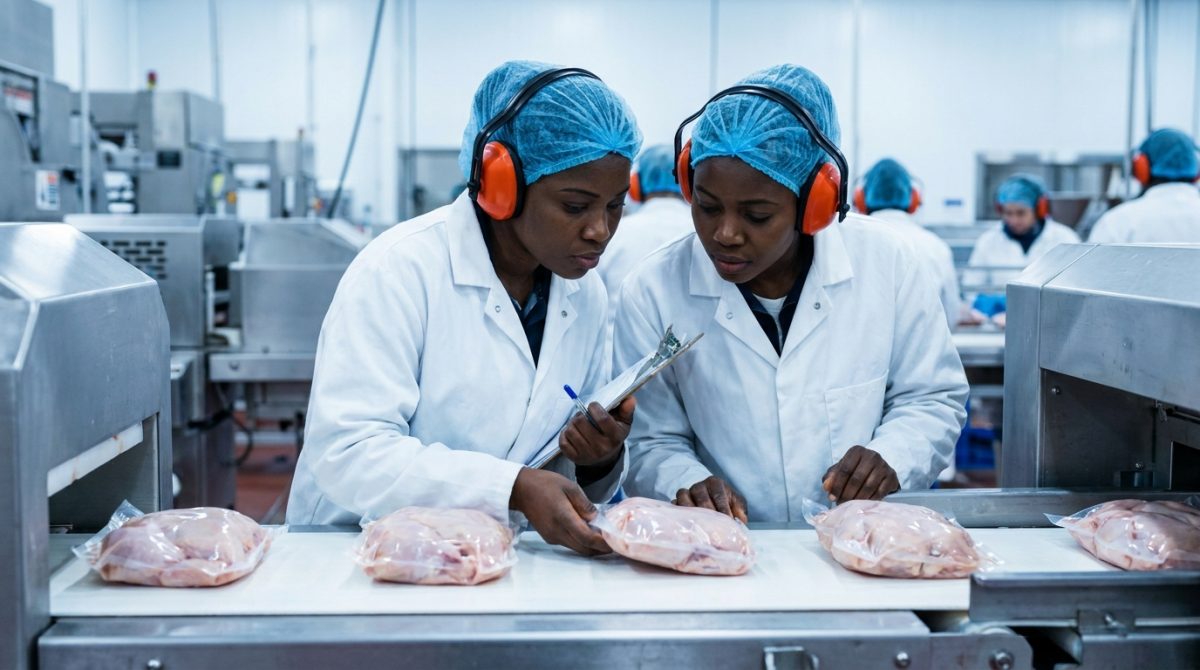
Understand the working conditions before you commit. Meat processing means standing for eight to ten hours in temperatures near freezing, performing repetitive knife work at line speed. Repetitive strain injury is common. This is legitimate, well-paid, legal work with a genuine route to permanent residence — but anyone describing it as easy is not being straight with you.
Major Food Processing Employers in Canada
These are among Canada’s largest processors and long-standing users of foreign worker programmes. Head office details verified against company-published sources in August 2026. Apply through their official careers portals, not through agents.
| Company | Head Office | Telephone | Website |
|---|---|---|---|
| Maple Leaf Foods | 6897 Financial Dr, Mississauga, ON L5N 0A8 | 1-800-268-3708 | mapleleaffoods.com |
| Olymel | 1620 Boul. de Montarville, Boucherville, QC J4B 8P4 | 450-645-1800 / 1-800-361-7990 | olymel.com |
| Cargill Canada | Plants in AB, ON, QC — see official site | Via official site | cargill.ca |
| JBS Canada | Brooks, Alberta operations | Via official site | jbsfoodsgroup.com |
| Sofina Foods | Multiple Canadian plants | Via official site | sofinafoods.com |
A note on verification: directory sites listed Maple Leaf Foods at a different street number than the company’s own locations page. We have used the company’s published address. This is a good illustration of why you should always confirm details on the employer’s official domain rather than a third-party listing.
Permanent Residence Pathways
This is where food processing genuinely outperforms other accessible sectors.
Provincial Nominee Programs
Manitoba, Alberta and Saskatchewan have all operated streams that accommodate food processing occupations, reflecting how dependent their rural economies are on these plants. A provincial nomination adds 600 CRS points, which effectively guarantees an Express Entry invitation. Employers in this sector often actively support nomination applications because retaining trained staff is in their interest.
Rural Community Immigration Pilot
Many processing plants sit in exactly the kind of small community RCIP was designed for. Several participating communities include food manufacturing on their priority occupation lists.
Atlantic Immigration Program
Seafood processing across New Brunswick, Nova Scotia, PEI and Newfoundland is a major AIP category, with designated employers able to support permanent residence directly.
| Programme | Open to TEER 4 Processing? | Best For | Official Source |
|---|---|---|---|
| Provincial Nominee Program | Yes — several dedicated streams | MB, AB, SK plant workers | Provincial sites |
| Atlantic Immigration Program | Yes | Seafood processing | canada.ca |
| Rural Community Immigration Pilot | Yes, in participating communities | Rural plant towns | canada.ca |
| Canadian Experience Class | No at TEER 4 | After moving to TEER 3 operator | canada.ca |
| Express Entry (FSW) | No at TEER 4 | Supervisors and QC only | canada.ca |

Settlement Benefits and Your Rights
| Benefit | On a Work Permit? | With PR? | Notes |
|---|---|---|---|
| Employer housing assistance | Yes, low-wage stream | — | Common in small plant towns |
| Private health insurance | Yes | — | Until provincial coverage begins |
| Public healthcare | Usually yes | Yes | Provincial |
| Free public schooling | Yes | Yes | Dependent children |
| Workers’ compensation | Yes | Yes | Critical — knife and RSI injuries are common |
| Union membership | Often | Often | Many large plants are unionised |
| Employer PNP support | Frequently | — | A real advantage of this sector |
| Path to citizenship | No | Yes | After three years of physical presence in five |
Many large Canadian processing plants are unionised, which matters more than it might sound. Union membership brings negotiated wage scales, grievance procedures, and protection against arbitrary dismissal — all significant when your immigration status is tied to one employer.
Requirements and Documents Checklist
- Valid international passport
- Signed job offer stating NOC code, wage, hours and shift pattern
- Positive LMIA number
- Any food handling or butchery experience evidence
- Police clearance certificates
- Panel physician medical
- Proof of funds for initial settlement
- Photographs to IRCC specification
Applying at the High Commission and Visa Verification
Canadian High Commission Contacts in Nigeria
| Office | Address | Telephone | |
|---|---|---|---|
| High Commission of Canada, Abuja | 13010G Palm Close, Diplomatic Drive, Central Business District, Abuja (P.O. Box 5144) | +234 (209) 461 2900 | abuja@international.gc.ca |
| Deputy High Commission of Canada, Lagos | 4 Anifowoshe Street, Victoria Island, Lagos | +234 201 271 5665 | lagosconsular-consulaire@international.gc.ca |
Mistakes to Avoid
- Accepting NOC 95106 when 94141 describes your actual work. This is the costliest error in the sector.
- Paying an agent for a plant job. The LMIA is the employer’s cost.
- Not asking about provincial nominee support. Good employers help; ask before accepting.
- Underestimating the physical demands. Cold, repetitive, fast-paced work.
- Skipping the union question. Ask whether the plant is unionised.
- Ignoring shift patterns. Night shifts pay more but affect family life.
- Not reporting injuries. Workers’ compensation exists for you; use it.
How to Apply for Food Processing Jobs in Canada With Visa Sponsorship
- Search Job Bank for NOC 94141, 94142 and 94211 roles open to LMIA candidates.
- Apply directly through the careers portals of the processors listed above.
- Target plants in Manitoba, Alberta, Saskatchewan and Atlantic Canada where PNP support is strongest.
- Confirm your NOC classification in writing before accepting.
- Ask explicitly whether the employer supports provincial nominee applications.
- Apply for the work permit through the IRCC secure account.
- Complete biometrics and the panel medical.
- On arrival, join the union if one exists and begin your PNP application as soon as eligible.
Frequently Asked Questions
Can I get a meat processing job in Canada with visa sponsorship and no experience?
Yes. Most large plants train workers on the line, and butchery experience is helpful but frequently not required. What matters is an employer holding a positive LMIA and your physical capability for the work.
How much do food processing workers earn in Canada?
Industrial butchers and meat cutters typically earn CAD $19 to $28 per hour, with night and weekend shift premiums on top. Process operators and supervisors earn more.
Why is food processing better than cleaning or hotel work for immigration?
Classification. Meat cutting is NOC 94141 at TEER 4, a step above general labouring, and several provinces run nominee streams built specifically around food processing. Cleaning and housekeeping sit at TEER 5 with far weaker permanent residence access.
Which provinces are best for food processing immigration?
Manitoba, Alberta and Saskatchewan have operated the most accessible streams for this sector, and Atlantic Canada is strong for seafood processing through the Atlantic Immigration Program.
Is the work physically difficult?
Yes. Expect eight to ten hour shifts standing in near-freezing temperatures doing repetitive knife work at line speed. Repetitive strain injury is a genuine occupational risk. It is well-paid legal work, but it is demanding.
Will my employer help me get permanent residence?
Many do, because retaining trained workers is commercially valuable to them. Ask directly during interview whether the company supports provincial nominee applications, and factor the answer into your decision.
Are Canadian meat plants unionised?
Many of the large ones are. Union membership brings negotiated wage scales and grievance protection, which matters considerably when your permit ties you to a single employer.
Can I bring my family?
At TEER 4 the position is better than TEER 5 roles but still not automatic. Confirm spousal open work permit eligibility for your specific NOC before making family plans.
What is the difference between NOC 94141 and NOC 95106?
NOC 94141 covers industrial butchers and meat cutters performing specific trade tasks, at TEER 4. NOC 95106 is general food processing labouring at TEER 5. The immigration difference is substantial, so ensure your classification reflects the work you actually do.
How long does the process take?
Typically six to fourteen months from job search to arrival. Permanent residence through a provincial stream usually follows one to two years after you start working.
Final Word
Food processing asks more of you physically than any other accessible route in this series, and gives more back in immigration terms. TEER 4 classification, dedicated provincial nominee streams, unionised workplaces and employers who actively want you to stay permanently is a combination no other entry-level sector offers.
Get your NOC classification right, ask about nominee support before you accept, and treat the provincial nomination as the objective from your first shift.
This article is general information, not legal advice. Immigration rules change frequently — confirm all requirements on canada.ca before acting. See our Disclaimer.